Photo by <a href="https://unsplash.com/@callas1900?utm_source=tokyodeepnightlife&utm_medium=referral">Ryo Tanaka</a> on <a href="https://unsplash.com/?utm_source=tokyodeepnightlife&utm_medium=referral">Unsplash</a>
Most travelers picture a Japanese festival as a daytime parade. In Tokyo, the best part usually starts when the sun goes down. Paper lanterns light up, food stalls fire up their grills, drums get louder, and whole neighborhoods spill into the street. If you want to catch a Tokyo night festival, or matsuri, this guide walks you through the season from the first shrine festivals of June to the lantern processions and rooster-day markets of autumn.
We’ve only included festivals whose dates and details we could check against the organizers’ own sites or several independent sources. Matsuri dates move from year to year, and some big ones only run at full scale every few years, so we give the usual timing plus the 2026 dates where they were published. Always check the official page before you go.
Contents
- What Makes a Matsuri Come Alive at Night
- Tokyo Summer Festivals After Dark (June to August)
- Tokyo Autumn Festivals at Night (September to November)
- Matsuri Calendar: Every Tokyo Night Festival at a Glance
- How to Enjoy a Tokyo Night Festival (Matsuri) Like a Local
- Is a Tokyo Night Festival Matsuri Worth Planning a Trip Around?
- What do you do in Tokyo After 10?Join our Tokyo Nightlife Private Tour
- Go Beyond the Festival With a Local Guide
- About the Author
What Makes a Matsuri Come Alive at Night
A matsuri is a festival tied to a shrine, a temple or a seasonal ritual. The religious core can be quiet and formal, but the community side is loud, social and very local. Night is when both come together.
A few things you’ll see at most evening festivals:
- Chochin (paper lanterns). Lanterns carry the names of sponsors, families and neighborhood associations. At some festivals, the lanterns are the main event.
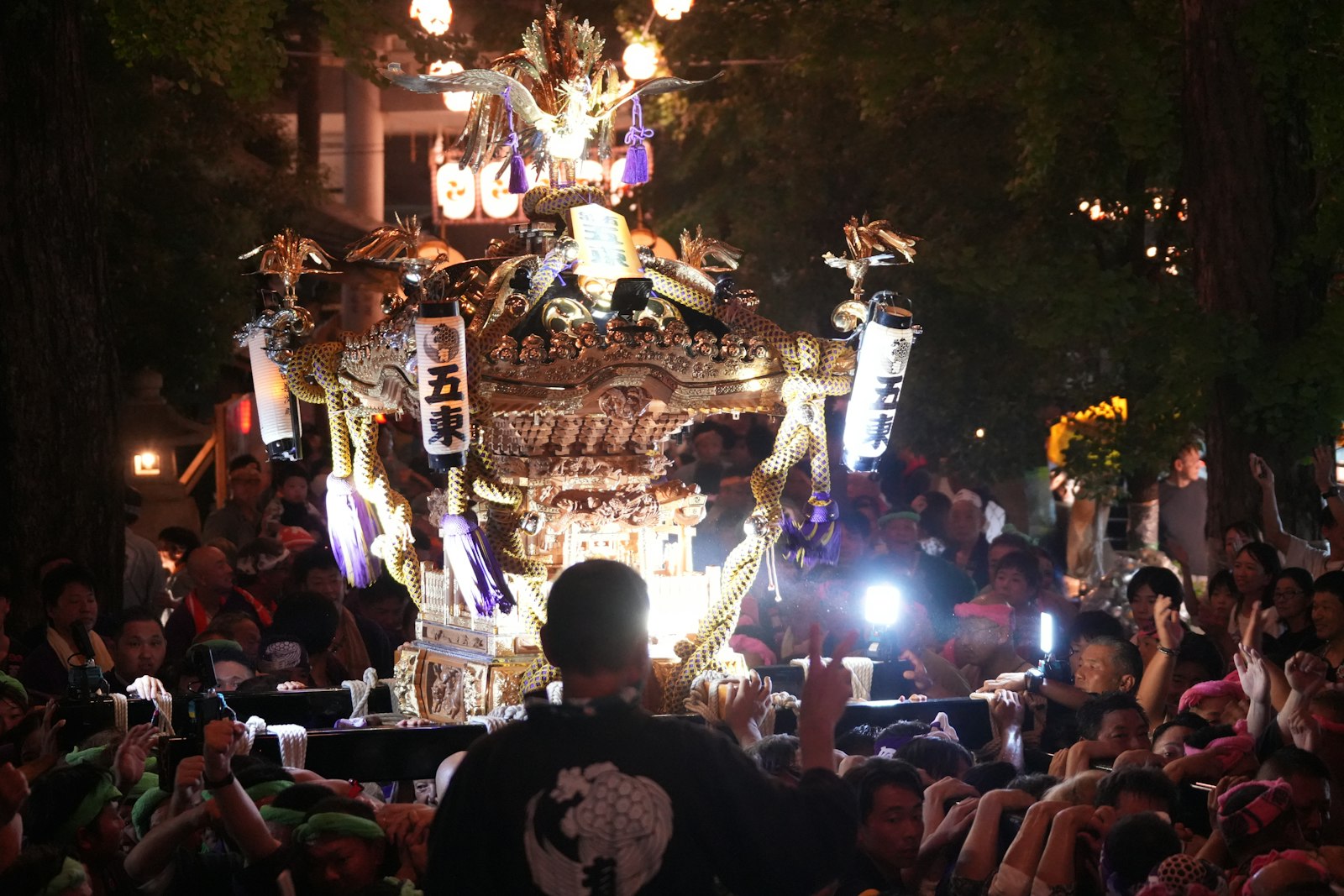
- Mikoshi (portable shrines). Teams carry the shrine’s deity through the streets, chanting as they go. Evening processions are often lit by tall lanterns on poles.
- Bon odori. A circle dance around a raised wooden stage called a yagura, held around Obon in summer. Anyone can join.
- Yatai (food stalls). Grilled squid, yakisoba, takoyaki, shaved ice and cold beer, usually lined up along the shrine approach.
The atmosphere after dark is the reason locals go. Office workers show up after work, kids run around in yukata, and the neighborhood drinks with people it only sees once a year.
Tokyo Summer Festivals After Dark (June to August)
Summer is peak Tokyo night festival matsuri season. Evenings are hot and humid, but that’s half the point: you eat shaved ice, drink a cold beer, and watch the crowd move.
Torigoe Matsuri (Early to Mid June, Taito Ward)
Torigoe Shrine, a short walk from Asakusa and Kuramae, holds one of the most famous night processions in Tokyo. Its main mikoshi is known as the sengan mikoshi, said to weigh around four tons, and it’s one of the heaviest portable shrines in the city.
The highlight comes on the Sunday evening. Around 7 pm, the lanterns around the mikoshi are lit, and over a hundred tall lanterns move with it as it heads back to the shrine. Locals call it “the Torigoe night festival” for good reason. In 2026 it was held on the weekend of June 6 and 7, so expect early to mid June in future years.
If you’ll be in the area anyway, our guide to Asakusa at night and the illuminated Senso-ji covers what else to do nearby.
Mitama Matsuri at Yasukuni Shrine (July 13 to 16)
Mitama Matsuri is Tokyo’s best-known lantern festival. According to Yasukuni Shrine, around 30,000 lanterns donated by families and supporters line the approach every year during the festival, which runs from July 13 to 16 to coincide with the Obon period. Event guides list the grounds as open until 9:30 pm, and the lanterns look best after about 7 pm, once it’s fully dark.
It’s worth knowing the context. Yasukuni Shrine enshrines Japan’s war dead, including people convicted of war crimes after World War II, and it’s a politically sensitive site in East Asia. Many visitors come simply for the lanterns and the summer evening, but treat the grounds with the respect you would any place of remembrance.
The nearest station is Kudanshita, on the Tozai, Hanzomon and Toei Shinjuku lines.
Sumidagawa Fireworks Festival (Last Saturday of July)
Fireworks aren’t a matsuri in the strict sense, but in Tokyo they’re part of the same summer night ritual: yukata, street food and a long wait for a good spot. The Sumidagawa Fireworks Festival is the biggest in the city. In 2026 it was held on July 25, with about 20,000 shells launched from two sites along the Sumida River between 7 pm and 8:30 pm.
The crowds are huge. If you don’t have a reserved seat or a friend with a balcony, arrive in the afternoon or watch from further away. Plan your way home before the last firework, too. Our guide to Tokyo last train times explains how to avoid getting stuck after a big event.
Tsukiji Hongwanji Bon Odori (Late July to Early August)
If you want to dance rather than watch, this is the one. Tsukiji Hongwanji, a temple near the Tsukiji Outer Market, hosts a bon odori on its front plaza over four nights each summer. In 2026 it ran from July 29 to August 1, with dancing in the evening from around 7 pm.
Don’t worry about knowing the moves: watch the dancers on the inner ring for a minute, then join the outer ring and copy them.
Fukagawa Hachiman Matsuri (Mid August, Koto Ward)
Tomioka Hachimangu’s summer festival is one of Edo’s three great festivals, and it’s famous for one thing: water. Spectators throw buckets of water over the mikoshi carriers to cool and purify them, which is why it’s also called the water-throwing festival.
Be honest with yourself about timing. The big joint procession of over 50 neighborhood mikoshi happens during the day, and the full-scale hon-matsuri only takes place every three years. The 2026 festival (August 12 to 16) was a full-scale year, so the next one is expected in 2029. In the other years the festival is smaller, but the evenings around the shrine still have stalls and a local crowd. The nearest station is Monzen-Nakacho.
Koenji Awa Odori (Last Weekend of August)
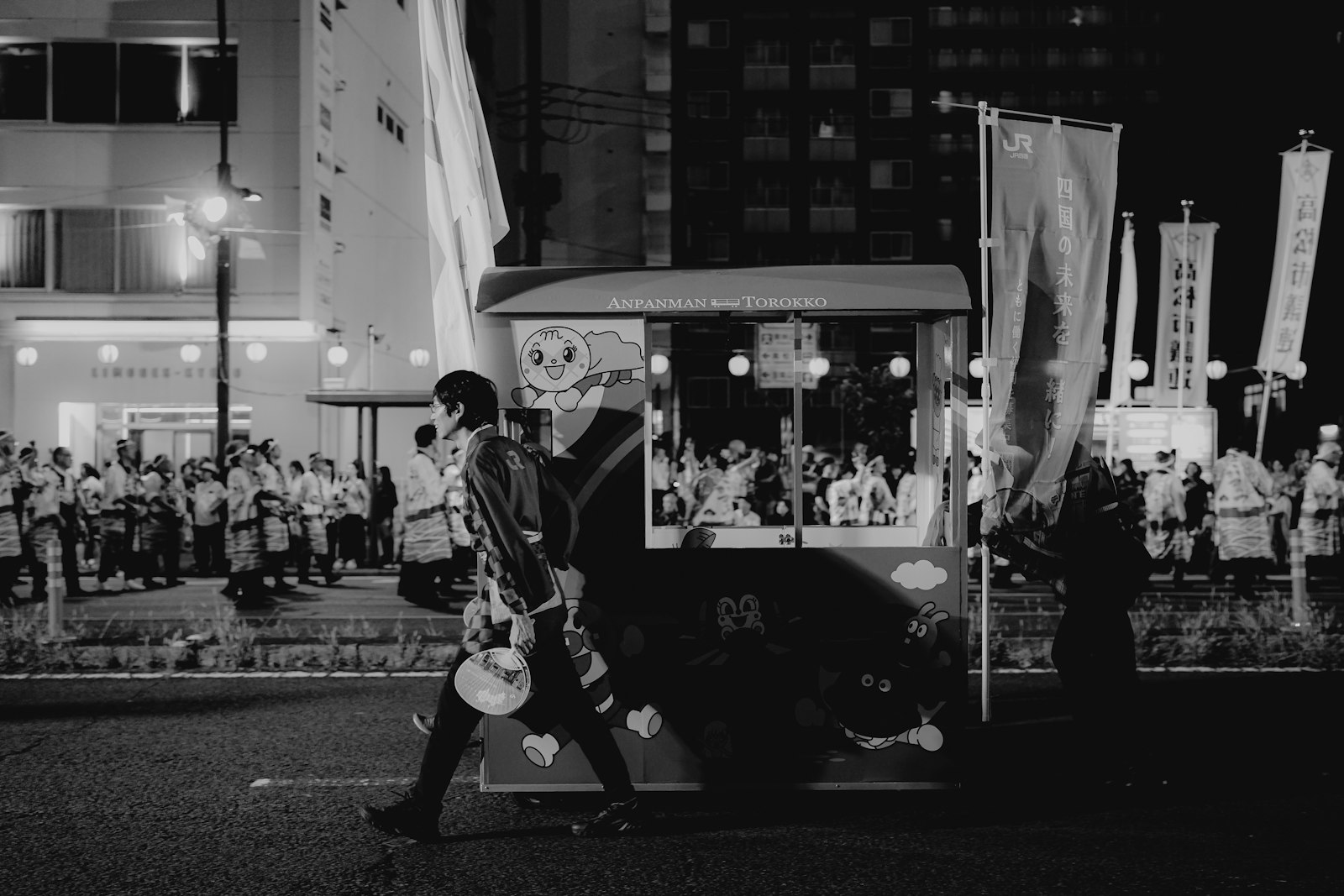
Tokyo’s biggest dance festival takes over the streets around Koenji Station each August. Awa Odori comes from Tokushima on the island of Shikoku, and the style is fast and loud: teams called ren dance through the streets to shamisen, drums and flutes, chanting as they go.
In 2026 it was held on August 29 and 30, from late afternoon into the evening, across the shopping streets around JR Koenji Station and along Konan-dori. Find a spot near a corner and the dancers will pass close enough to touch. On festival days, Chuo Line rapid trains have been reported to skip Koenji, so check the official site and plan to use the local Chuo-Sobu Line.
For bars, beer gardens and rooftops to go to after a summer festival, see our guide to Tokyo nightlife in summer.
Tokyo Autumn Festivals at Night (September to November)
Most English-language guides treat Tokyo night festival matsuri season as a summer-only thing and stop at the end of August. That’s a mistake. Autumn evenings are cooler, the crowds are often smaller, and several of Tokyo’s most striking night festivals happen between September and November.
Nezu Shrine Reitaisai (Late September, Bunkyo Ward)
Nezu Shrine sits in the old Yanaka-Nezu-Sendagi area, one of the few parts of Tokyo with a real old-town feel. Its annual grand festival takes place in late September (September 26 and 27 in 2026). According to Tokyo’s official tourism site, there are taiko drum and sacred dance performances, and stalls fill the large shrine grounds.
The mikoshi procession only runs every four years, and 2026 was one of those years. Even in quieter years, an evening walk through the stalls and then on to a small Yanaka bar makes a good autumn night out. Nezu Station on the Chiyoda Line is about a five-minute walk away.
Ikegami Honmonji Oeshiki (October 11 to 13)
This is the night festival most travelers have never heard of, and one of the most memorable. Ikegami Honmonji, a large Nichiren Buddhist temple in Ota Ward, marks the anniversary of the death of the monk Nichiren every October.
The main event is the Mando Neri Kuyo on the night of October 12. According to the temple, a procession of about 3,000 people from more than a hundred groups walks around two kilometers to the temple between 6 pm and roughly 11 pm. They carry mando, tall towers covered in paper cherry blossoms and lit from inside, while drummers and flute players keep up a fast, hypnotic rhythm. The temple says over 300,000 people visit in that single night.
The 2026 Oeshiki has just finished, but it falls on the same dates every year, so October 12 is a reliable date to plan around. The closest station is Ikegami on the Tokyu Ikegami Line.
Kawagoe Matsuri (Third Weekend of October, Saitama)
Kawagoe is just outside Tokyo, about half an hour by train from Ikebukuro, and its autumn festival is worth the trip. The official site says it’s held every year on the third Sunday of October and the Saturday before. In 2026, that’s October 17 and 18.
Huge decorated floats are pulled through the old town of clay-walled warehouses. The best part is at night, during the hikkawase: when floats meet at an intersection, they turn to face each other and the musicians and dancers on each one try to outplay the other, surrounded by crowds holding lanterns. The Kawagoe float festival is one of the events listed together by UNESCO as Japan’s “Yama, Hoko, Yatai” float festivals.
Tori no Ichi at Otori Shrine, Asakusa (November)
Tori no Ichi is a market held on the “days of the rooster” in November, based on the old Japanese calendar. The biggest one is at Otori Shrine near Asakusa. Stalls sell kumade, decorated bamboo rakes meant to “rake in” good luck for businesses.
What makes it a night event is that it never stops. Otori Shrine says each Tori no Ichi day runs from midnight to midnight. In 2026, the shrine has announced the first rooster day (ichi no tori) for November 7 and the second (ni no tori) for November 19, with no third this year.
The best moment comes when a business owner buys a large kumade. The stall staff and everyone nearby break into rhythmic clapping, called tejime, to seal the deal. According to Japanese guides, the daytime crowds can mean long waits to pray, while mornings and late nights are calmer. Late at night is when it feels most like old Edo.
Looking for Adult Entertainment Services in Tokyo? Download this
I’ve spent over a decade exploring and studying Japan’s adult entertainment scene firsthand. If you’d like detailed insider information—including how to choose the right shop, what services are available, and tips for avoiding common mistakes—check out our exclusive E-book.
Matsuri Calendar: Every Tokyo Night Festival at a Glance
| Season | Festival | Usual timing | Why go at night |
|---|---|---|---|
| June | Torigoe Matsuri | Early to mid June weekend | Lantern-lit mikoshi returns to the shrine |
| July | Mitama Matsuri | July 13 to 16 | Around 30,000 lanterns |
| July | Sumidagawa Fireworks | Last Saturday of July | 20,000 fireworks over the river |
| July to August | Tsukiji Hongwanji Bon Odori | Four nights, late July to early August | Open dance circle |
| August | Fukagawa Hachiman Matsuri | Mid August | Evening stalls; full scale every three years |
| August | Koenji Awa Odori | Last weekend of August | Dance teams fill the streets |
| September | Nezu Shrine Reitaisai | Late September | Stalls in an old-town shrine |
| October | Ikegami Honmonji Oeshiki | October 12 (night) | Lit-up mando procession |
| October | Kawagoe Matsuri | Third weekend of October | Float face-offs by lantern light |
| November | Tori no Ichi | November rooster days | 24-hour market and tejime clapping |
If you’re choosing when to visit Tokyo for festivals and nightlife together, our month-by-month Tokyo nightlife guide can help you pick.
How to Enjoy a Tokyo Night Festival (Matsuri) Like a Local
Festivals are free and open to everyone, but they’re community events first. A few habits will make your night smoother.
Bring Cash in Small Notes
Yatai stalls mostly work in cash. Some now take QR-code payments, but card readers are rare. Bring ¥1,000 notes and coins. Breaking a ¥10,000 note at a busy stall slows down the whole line.
Eat Like the Neighborhood
The classics are yakisoba, takoyaki, grilled squid, yakitori, jaga-butter (a buttered potato), choco-banana and kakigori shaved ice. Most stalls ask you to eat nearby rather than walking through the crowd with food. Look for the trash and recycling stations, which are often run by volunteers, and sort your waste there.
Respect the Mikoshi and the Ritual
Don’t touch a mikoshi or try to jump in with the carriers unless a team invites you. Don’t block the route for photos, and step back when a procession turns. Some rituals inside shrine halls don’t allow photography, so follow the signs.
Yukata Are Welcome, Not Required
You’ll see plenty of locals in yukata, especially at summer festivals. Visitors wearing them are welcome. If you’d rather not, wear light clothes and comfortable shoes. Bring a small towel, a fan and water in summer, as Tokyo summer evenings stay hot and humid well after dark.
Time It Right
Arriving just before dusk gives you the shift from daylight to lanterns, which is the best photo window. Crowds usually peak in the early evening. For the biggest events, leave before the final moment or wait out the rush at a nearby bar, then take the train once the platforms clear.
Is a Tokyo Night Festival Matsuri Worth Planning a Trip Around?
For most visitors, yes, if you can match your dates. A neighborhood matsuri is one of the few times you see Tokyo’s locals let loose in public, and it’s free. The tricky part is that information in English is scattered, dates change, and the best moments, like a mikoshi returning to its shrine, last only a few minutes and happen in specific streets.
The good news is that a festival makes a perfect start to a longer night. The neighborhoods that host the best matsuri, like Asakusa, Koenji and the old shitamachi districts, are also full of small izakaya and standing bars where the post-festival crowd ends up. The Japan National Tourism Organization’s Tokyo travel pages and GO TOKYO are good places to check upcoming events.
What do you do in Tokyo After 10?
Join our Tokyo Nightlife Private Tour
You deserve better than overpriced bars and missed opportunities. We’re here for you.
Go Beyond the Festival With a Local Guide
A festival night is better when someone can tell you what’s going on in front of you: why the carriers chant, which stall is worth the line, and which side street leads to a bar full of locals still in their happi coats. If you want that kind of night, our Tokyo After 10 private nightlife tour pairs you with a local guide who knows the back streets, the etiquette and where the night goes next. Tell us when you’re in town, and we’ll help you fit a matsuri into a night you’ll remember.