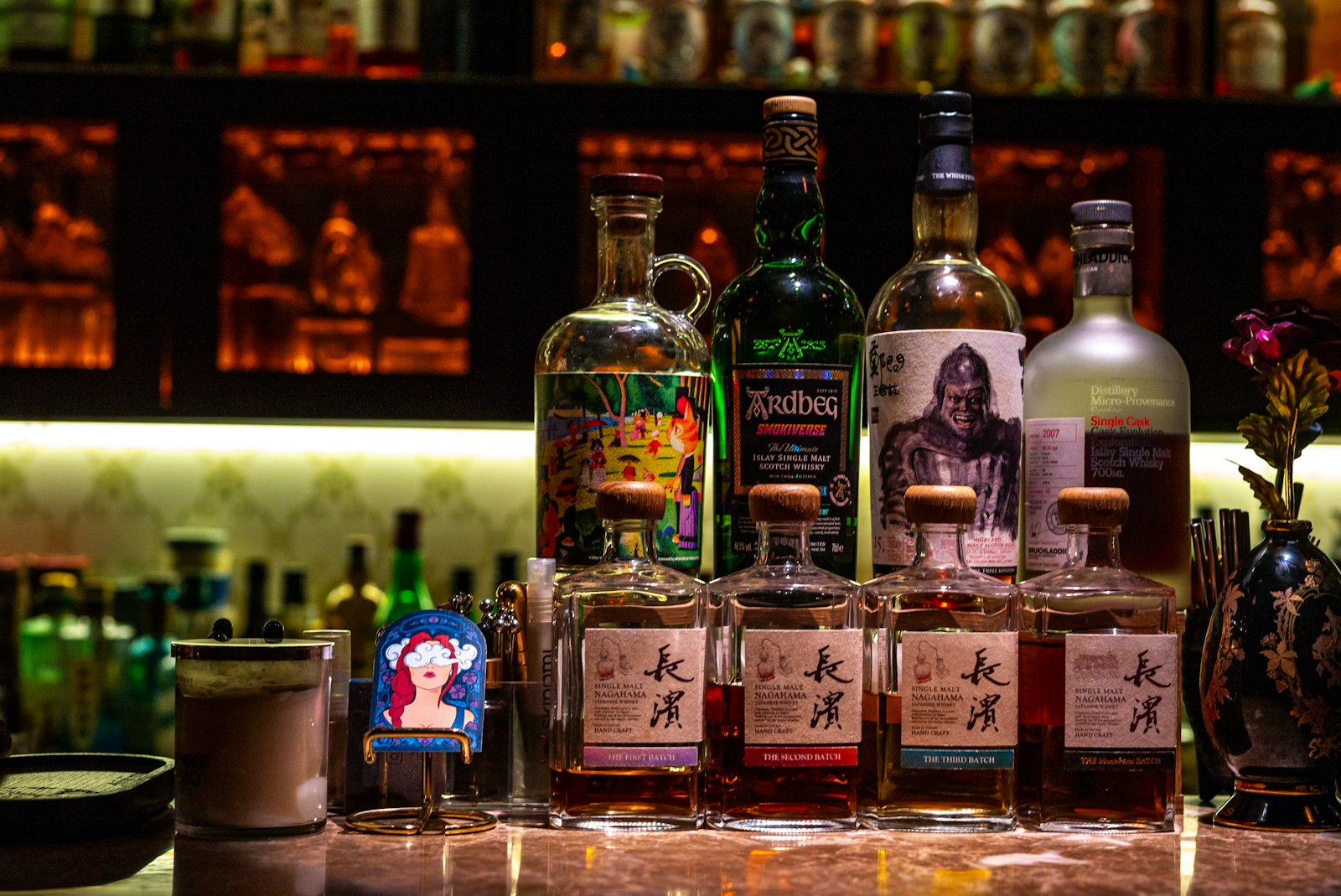
Photo by <a href="https://unsplash.com/@alschim?utm_source=tokyodeepnightlife&utm_medium=referral">Alexander Schimmeck</a> on <a href="https://unsplash.com/?utm_source=tokyodeepnightlife&utm_medium=referral">Unsplash</a>
If you want the number before the explanation: a first visit to a standard Tokyo hostess club runs about ¥15,000–¥25,000 per person for an hour or two. But the honest answer to “hostess club price how much will I actually pay” is that almost nobody pays the number printed on the sign outside. The set fee you see quoted is the starting line, not the finish line.
That gap is where travelers get burned. Not by scams, usually — by arithmetic. A ¥6,000 hourly rate turns into a ¥24,000 bill through a completely legitimate chain of nomination fees, extensions, hostess drinks, a service charge, and consumption tax, each one small and each one applied on top of the last.
This guide does the math that most articles skip. Below you’ll find every line item that can appear on a kyabakura bill, three worked sample checks from real price structures, district-by-district budgets, and the specific questions to ask at the door so the total never surprises you.
Contents
- The Short Answer: Hostess Club Price at a Glance
- The Set Fee: The Number on the Sign
- Shimei: What Choosing Your Hostess Costs
- Extensions: Where One Hour Quietly Becomes Three
- Drinks, Hostess Drinks, and Bottle Keep
- The 30% Multiplier: Service Charge and Tax
- Three Sample Bills, Fully Calculated
- Hostess Club Price by District
- Why Your Bill Came Out Higher Than You Expected
- How to Keep the Price Under Control
- Red Flags: When the Price Isn’t a Price
- Cheaper Alternatives Worth Knowing About
- “Hostess Club Price How Much?” — Your Questions Answered
- What do you do in Tokyo After 10?Join our Tokyo Nightlife Private Tour
- Skip the Guesswork
- About the Author
The Short Answer: Hostess Club Price at a Glance
| What you’re paying for | Typical range | Notes |
|---|---|---|
| Set fee (per person, per hour) | ¥3,000–¥15,000 | ¥3,000–¥8,000 in Kabukicho; ¥10,000+ in Ginza |
| Nomination fee (shimei) | ¥1,000–¥5,000 | Optional, but most people end up paying it |
| Extension (per 30 min) | ¥3,000–¥8,000 | Roughly half a set fee |
| Extension (per 60 min) | ¥5,000–¥10,000 | |
| Your drinks | Often included | House shochu and whisky are commonly in the set |
| A drink for your hostess | ¥1,000–¥3,000 each | This is the one that adds up |
| Bottle (keep) | ¥10,000–¥50,000+ | Entry-level bottles from around ¥4,000 |
| Service charge | 10–30% | Applied to the subtotal |
| Consumption tax | 10% | Applied on top |
| Credit card surcharge | 10–20% | Not every venue, but common enough to ask |
Realistic totals per person:
- Casual Kabukicho or Ikebukuro venue, one hour, no nomination: ¥8,000–¥12,000
- Standard first visit, one to two hours, with a nomination: ¥15,000–¥25,000
- Upscale Ginza or Roppongi lounge: ¥30,000–¥50,000 and up
Everything after this point explains how you get from the first column to the last.
The Set Fee: The Number on the Sign
The set fee (セット料金) is the base charge for sitting down for a fixed block of time. In a standard Shinjuku or Ikebukuro kyabakura, expect ¥3,000–¥8,000 per person per hour. Across Tokyo as a whole, main-floor set fees span roughly ¥5,000–¥15,000.
Two details about the set fee cost people real money:
The block is often not sixty minutes. Many venues sell a “one hour” set that is actually 45 or 50 minutes of clock time. The remaining ten or fifteen minutes is when your hostess will ask, warmly and at exactly the right moment, whether you’d like to extend. Ask how many minutes the set is — in minutes, not in hours — before you sit.
First-visit rates are real but conditional. Discounted trial sets, sometimes 60 to 90 minutes, are a genuine and common promotion. They’re also usually the version of the price that gets advertised. If a rate is described as a first-visit price, confirm what the second-visit price is before you decide whether you’re coming back.
The set fee typically includes house drinks for you — all-you-can-drink shochu and whisky is standard at most kyabakura. That’s genuinely good value, and it is also why the drinks line on your bill is almost never about your own glass.
Shimei: What Choosing Your Hostess Costs
Without a nomination, hostesses rotate through your table every 15 to 20 minutes. You meet several people, none of them for long, and the conversation restarts each time.
A nomination fee (指名料, shimei-ryō) of ¥1,000–¥5,000 buys you the opposite: one hostess stays with you for your whole set. Most venues sit in the ¥1,000–¥3,000 band; Ginza clubs run higher.
This is optional in the strict sense and near-mandatory in the practical one. The rotation system is designed to make you want to stop it. If you enjoy anyone’s company at all, you will want them to stay, and that is the entire mechanism. Budget for the nomination from the start rather than treating it as a surprise, and you’ll make a calmer decision about it.
There’s also dōhan — arriving with a hostess you’ve arranged to meet beforehand, usually over dinner. It carries its own fee at most clubs and belongs to the repeat-customer world rather than the first-visit one. If you’re reading a pricing guide, you don’t need it yet.
Extensions: Where One Hour Quietly Becomes Three
Extensions are billed in 30-minute increments at roughly half your set fee — ¥3,000–¥8,000 — or in 60-minute blocks at ¥5,000–¥10,000.
The arithmetic is not the problem. The problem is that the question arrives when you’re two drinks in, enjoying yourself, and being asked by someone you like. Decide your total time before you walk in and say it out loud at the table: “I have one hour.” Stating a limit early is normal, expected, and not remotely rude. Deciding at minute 48 is how a ¥10,000 night becomes a ¥35,000 one.
Drinks, Hostess Drinks, and Bottle Keep
Your own drinks are usually covered by the set. Drinks for your hostess are not, and they run ¥1,000–¥3,000 each.
Here is the part worth internalizing: a hostess’s income is tied to the drinks ordered at her table. She will ask. Over a two-hour set, three or four hostess drinks is entirely ordinary, which is ¥4,500–¥12,000 before service charge and tax — frequently more than the set fee that brought you in the door.
Saying no is fine. “Not right now, thanks” is a complete sentence and no one will hold it against you. Saying yes four times without tracking it is what produces the bill people write angry reviews about.
Bottle keep is the upgrade path: you buy a full bottle, the club stores it with your name on it, and you drink from it on future visits. Entry-level bottles start around ¥4,000, the common mid-range sits at ¥10,000–¥50,000, and the ceiling does not exist. It only makes economic sense if you’re genuinely coming back — which, for most visitors on a two-week trip, means it doesn’t.
The 30% Multiplier: Service Charge and Tax
This is the single most under-explained part of hostess club pricing, and it’s why totals land where they do.
Every line above is a subtotal. On top of it:
- Service charge: 10–30% of the subtotal
- Consumption tax: 10% on top of that
- Credit card surcharge: 10–20% at venues that levy one
A club advertising a 20% service charge plus 10% tax is telling you the final number is 30% above every price on the menu. Industry-wide, the finished total commonly runs 20–40% higher than the menu lines. Pay by card at a venue with a surcharge and you can clear 50%.
None of this is a scam. It’s all disclosed, usually on a printed card at the table. It’s just that almost no first-time visitor multiplies before ordering, and multiplying before ordering is the whole skill.
Three Sample Bills, Fully Calculated
A. Casual Kabukicho venue, one hour, no nomination
| Line | Amount |
|---|---|
| Set fee, 60 min | ¥5,000 |
| One hostess drink | ¥1,500 |
| Subtotal | ¥6,500 |
| Service charge (20%) | ¥1,300 |
| Consumption tax (10%) | ¥780 |
| Total | ≈ ¥8,600 |
B. Standard Shinjuku club, two hours, with nomination
| Line | Amount |
|---|---|
| Set fee, 60 min | ¥6,000 |
| Extension, 60 min | ¥6,000 |
| Nomination fee | ¥2,000 |
| Hostess drinks × 3 | ¥4,500 |
| Subtotal | ¥18,500 |
| Service charge (20%) | ¥3,700 |
| Consumption tax (10%) | ¥2,220 |
| Total | ≈ ¥24,400 |
Add a 15% card surcharge and that becomes roughly ¥28,000. Note what happened: the set fee was ¥6,000, and the bill was four times that. Nothing irregular occurred.
C. Upscale Ginza club
Ginza Club Passtone publishes its rates in English on its own website, which makes it a useful benchmark for the high end: a 60-minute seating charge of ¥19,500, ¥5,200 per 30-minute extension, a ¥3,900 nomination fee, and bottles from ¥20,800 — with a stated 20% service charge and 10% consumption tax added on top. The club’s own estimate for a first-time visitor is ¥30,000–¥50,000.
That figure is consistent with the wider market: upscale Ginza and Roppongi lounges generally start at ¥30,000 per person and climb from there.
Looking for Adult Entertainment Services in Tokyo? Download this
I’ve spent over a decade exploring and studying Japan’s adult entertainment scene firsthand. If you’d like detailed insider information—including how to choose the right shop, what services are available, and tips for avoiding common mistakes—check out our exclusive E-book.
Hostess Club Price by District
| District | Typical set fee/hr | Realistic per-person total | Character |
|---|---|---|---|
| Kabukicho / Shinjuku | ¥3,000–¥8,000 | ¥10,000–¥25,000 | Highest density, widest quality spread, most touts |
| Ikebukuro | ¥3,000–¥7,000 | ¥8,000–¥20,000 | Cheaper and more relaxed than Kabukicho |
| Shibuya | ¥4,000–¥8,000 | ¥12,000–¥25,000 | Younger crowd, fewer English-capable venues |
| Roppongi | ¥5,000–¥15,000 | ¥20,000–¥50,000 | Most foreigner-facing, also the most rip-off risk |
| Ginza | ¥10,000–¥20,000 | ¥30,000–¥50,000+ | Formal, referral-oriented, expensive by design |
Kabukicho has both the cheapest legitimate venues and the worst traps, sometimes on the same block. Our Kabukicho nightlife guide covers how the district is laid out and which streets to be deliberate about.
Why Your Bill Came Out Higher Than You Expected
Assuming nothing dishonest happened, it’s almost always one of these six:
- You multiplied nothing. Service charge and tax added 30% you hadn’t counted.
- The “hour” was 50 minutes, so you extended without quite meaning to.
- Hostess drinks accumulated — four at ¥2,000 is ¥8,000 before the multiplier.
- The advertised rate was a first-visit promotion and something in your order fell outside it.
- You paid by card at a venue with a surcharge.
- You were charged per person, not per table. Every price in this article is per head. Two people doubles everything.
How to Keep the Price Under Control
- Ask for the total, not the rate. The correct question at the door is “For one hour, one person, with a nomination — what is the final total including service charge and tax?” A legitimate venue answers with a number. Vagueness is the signal.
- Ask for the printed price card and photograph it before you order anything.
- State your time limit out loud when you sit down.
- Ask before every hostess drink whether it’s on the set — sometimes one is included.
- Confirm the card surcharge before paying, and carry enough cash to pay in cash if the answer is bad.
- Set a hard walk-away number in your head. ¥20,000 is a sensible first-visit ceiling.
- Never enter with a street tout. More on this immediately below.
Red Flags: When the Price Isn’t a Price
Legitimate hostess clubs are expensive and transparent. The dangerous venues are the ones where the price is a moving target — and they cluster in exactly the districts you’re most likely to visit.
Tokyo Metropolitan Police have stepped up patrols against Kabukicho venues that overcharge customers, and the U.S. Embassy has repeatedly warned about drink spiking and inflated bills in Roppongi and Kabukicho, including cases where victims’ credit cards were charged multiple times or run for enormous sums while they were incapacitated.
The consistent thread in nearly every one of these cases is the same: the customer was brought in by a street tout. Not a sign, not a search, not a booking — a friendly man on the pavement who spoke good English and offered a great price.
Concrete rules:
- Never follow a tout. No exceptions, however reasonable they seem.
- Never accept a drink you didn’t watch being poured.
- Refuse to hand over your card before you’ve seen an itemized bill.
- If the price you were quoted outside doesn’t match the price inside, leave immediately. You are allowed to walk out.
- If a bill is genuinely fraudulent, call the police (110). Venues that overcharge tourists are counting on you not doing this.
Our breakdown of how tourists actually get ripped off in Kabukicho walks through the specific mechanics if you want the longer version.
Cheaper Alternatives Worth Knowing About
If ¥20,000 isn’t the night you had in mind, the format has cheaper cousins.
A girls bar is a counter-service bar where staff serve and chat from behind the bar rather than sitting at your table. It’s typically ¥3,000–¥5,000 for an hour, there’s usually no nomination fee, and the whole atmosphere is lower-pressure. We compare the two formats directly in girls bar vs hostess club, and if you’d rather start somewhere English-friendly, our guide to foreigner-friendly girls bars in Tokyo narrows it down further.
Host clubs are the same business model with the genders reversed, and the pricing follows an almost identical structure.
And for etiquette, language, and what a visit actually feels like from the door to the checkout, our full hostess club Tokyo guide covers the ground this pricing article deliberately doesn’t.
“Hostess Club Price How Much?” — Your Questions Answered
How much is a hostess club in Tokyo for one hour? Between about ¥8,000 and ¥12,000 all-in at a standard Kabukicho or Ikebukuro venue with no nomination. With a nomination and a couple of hostess drinks, ¥15,000–¥20,000 is more realistic. Ginza starts around ¥30,000.
Is the hostess club price per person or per table? Per person, essentially always. Set fees, nomination fees and extensions all multiply by headcount.
Do I have to pay a nomination fee? No. Without it, hostesses rotate every 15–20 minutes. Most people end up paying it anyway.
Are drinks included? Your own usually are — house shochu and whisky are standard in the set. Drinks for your hostess are extra, at ¥1,000–¥3,000 each.
Can I pay by credit card? Usually, but expect a possible 10–20% surcharge. Ask before you order, and carry cash as a fallback.
Do hostess clubs accept foreigners? Many do, some don’t, and a polite refusal at the door is about language capacity rather than hostility. Venues in Roppongi and parts of Kabukicho are the most accustomed to English-speaking customers.
Is tipping expected? No. The service charge already covers it, and tipping isn’t part of Japanese practice.
What do you do in Tokyo After 10?
Join our Tokyo Nightlife Private Tour
You deserve better than overpriced bars and missed opportunities. We’re here for you.
Skip the Guesswork
Hostess club pricing isn’t complicated once you can see it — set fee, nomination, extension, drinks, then multiply by 1.3. The hard part isn’t the math. It’s standing on a Kabukicho street at 10pm trying to work out which of forty near-identical doorways charges what it says it charges.
That’s the exact problem a local guide solves. Our Tokyo After 10 nightlife tour takes you into venues that have been vetted for transparent pricing and are used to foreign guests, with someone beside you who can ask the awkward questions in Japanese and read the price card before you sit down. You get the experience without paying tuition for it.
Because the most expensive hostess club price is the one you didn’t ask about.
Prices in this article reflect commonly published rates as of 2026 and vary by venue, district, and season. Always confirm the total — including service charge and tax — before you sit down.