Photo by <a href="https://unsplash.com/@tokyoluv?utm_source=tokyodeepnightlife&utm_medium=referral">TOKYOLUV</a> on <a href="https://unsplash.com/?utm_source=tokyodeepnightlife&utm_medium=referral">Unsplash</a>
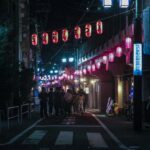
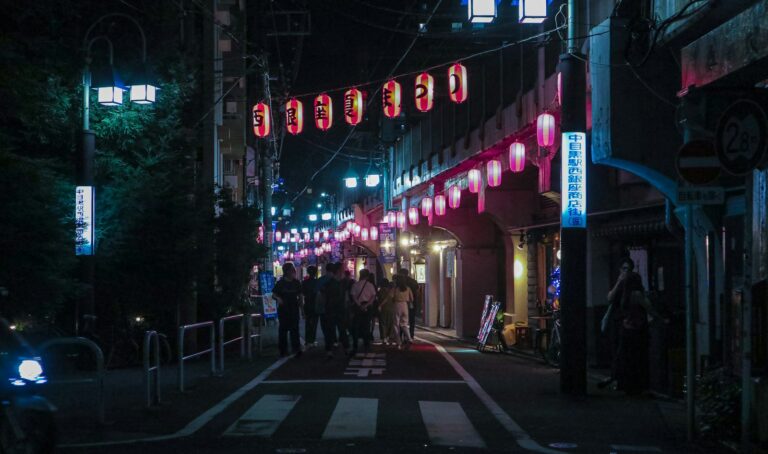
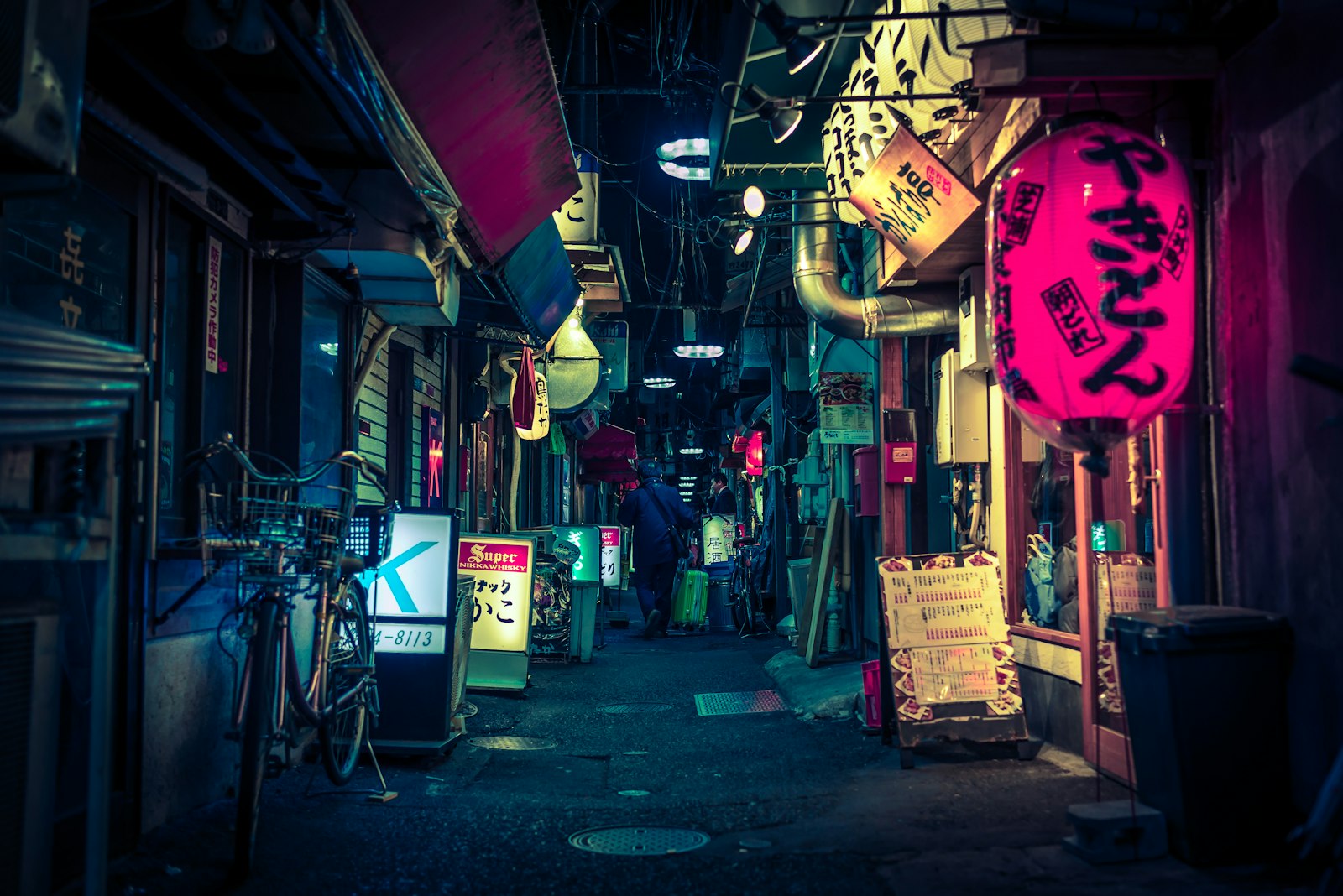
There’s a moment that happens to almost every first-time visitor in Shinjuku. You’re walking down a wide, bright street lined with chain restaurants, you glance to your right, and there’s a gap between two buildings barely wide enough for one person. Down it: red lanterns, smoke, the sound of forty people talking at once. That gap is a yokocho, and the yokocho Tokyo alley bars hidden inside are where the city actually drinks.
The word yokocho (横丁) just means “side alley.” In practice it’s shorthand for a specific kind of place — a cluster of postwar-era lanes packed with bars and grills so small that six customers constitutes a full house. There are dozens of them across Tokyo. Most guides cover two, maybe three, and send everyone to the same two blocks of Shinjuku.
This is the map version. Nine districts, spread from Kichijoji in the west to Ueno in the northeast, with what each one is actually good for, what a night costs, how to behave once you’ve squeezed onto a stool, and what to order when the menu is a handwritten sheet of kanji on the wall.
Contents
- What a Yokocho Actually Is
- The Tokyo Yokocho Map: 9 Alley Districts Worth a Night
- Which Yokocho Should You Actually Pick?
- Yokocho Tokyo Alley Bars: What a Night Costs
- Yokocho Etiquette: What Actually Matters
- What to Order: A Back-Alley Food Glossary
- Practical Logistics
- Yokocho Tokyo Alley Bars FAQ
- What do you do in Tokyo After 10?Join our Tokyo Nightlife Private Tour
- See the Alleys With Someone Who Knows the Doors
- About the Author
What a Yokocho Actually Is
A yokocho isn’t a bar. It’s a street — or more accurately, a warren of streets — where the buildings are subdivided into the smallest commercially viable units anyone has ever attempted.
The defining feature is size. A typical yokocho bar seats six to twelve people, almost always at a counter, with the owner working the grill about eighteen inches from your face. Some don’t have seats at all: tachinomi (立ち飲み), standing bars, where you lean against a shelf and drink upright. There’s no table service because there are no tables. There’s no waiter because the person pouring your beer is also the person who owns the building’s lease.
This is what separates yokocho Tokyo alley bars from the rest of the city’s drinking: the room is the constraint, and everything else follows from it.
You’ll recognise the establishments by the red paper lantern (akachōchin) outside and the short split curtain (noren) hanging in the doorway. Curtain down means open. That’s the entire signage system, and it hasn’t changed in seventy years.
Why they exist: the black market origin story
Nearly every yokocho in Tokyo traces back to the same eighteen months.
After the 1945 firebombing, huge stretches of central Tokyo were flattened, food was rationed, and unofficial markets sprang up in the rubble around major stations — the places where people arrived, and therefore where goods could be moved. Around 1946, the ruined ground west of Shinjuku Station hosted a black market of street vendors partitioned from each other by single door boards. That market is the direct ancestor of Omoide Yokocho. Kichijoji’s Harmonica Yokocho grew out of a market that appeared in front of its station in 1945. Shibuya’s Nonbei Yokocho formed around 1950–51 on ground that had been a postwar black-market zone.
Through the 1950s these markets were gradually licensed, formalised, and rebuilt — but on the original footprint. That’s why the lanes are the width of a wartime footpath and the buildings are the width of a stall. Tokyo grew around them and, in a handful of places, simply never got around to knocking them down.
Understanding this changes how the alleys read. The cramped weirdness isn’t a design choice or a retro theme. It’s a preserved accident.
The Tokyo Yokocho Map: 9 Alley Districts Worth a Night
Ordered roughly west to east, so you can slot one into wherever you already are. Between them these nine districts cover almost every version of the yokocho Tokyo alley bars experience — from the six-seat, Japanese-only counter to the covered arcade with English menus.
1. Omoide Yokocho — Shinjuku West Exit
The most photographed alley in Japan, and about a one-minute walk from the JR Shinjuku west exit. Roughly 80 premises are crammed into around 2,000 square metres, of which some 60 are bars and restaurants — overwhelmingly yakitori (chicken skewers) and motsuyaki (grilled offal), with a few soba counters and a couple of offal hot-pot places mixed in.
You may see it called “Piss Alley,” a nickname from the era before the lanes had plumbing. Nobody local uses it; it’s a tourist artefact.
Go here for: smoke, char, and the single most concentrated hit of postwar Tokyo atmosphere available. It’s also the easiest to reach — you can be standing in it four minutes after stepping off a Yamanote train.
Be aware: it is genuinely crowded, and the front-facing counters nearest the station entrance get the heaviest tourist traffic. Walk to the far end before you commit. Our Omoide Yokocho guide to Shinjuku’s Memory Lane breaks down the individual lanes and ordering in detail.
2. Golden Gai — Shinjuku, East Side
Six narrow alleys connected by even narrower passageways, sitting between the Shinjuku City Office and Hanazono Shrine, holding over 200 bars. Not restaurants — bars. Golden Gai is for drinking and talking, not eating, and the distinction matters when you’re planning the night.
It has the most character and the steepest learning curve of anywhere on this list. Many bars are one-room affairs with five stools and a fiercely specific personality: a jazz bar, a punk bar, a bar run by a film editor that only plays soundtracks. Some welcome newcomers warmly. Some have a sign at the door saying regulars only, and mean it.
After the 1958 anti-prostitution law came into force, the area converted wholesale into the bar district it is today, and it spent the following decades as a haunt of writers, directors, and musicians. That legacy is still the reason people go.
Go here for: conversation, eccentricity, and the chance of an evening you couldn’t have planned.
Be aware: cover charges are real and are the number one source of visitor complaints. See the cost section below, and read our complete Golden Gai guide before your first visit.
3. Nonbei Yokocho — Shibuya
“Drunkard’s Alley,” and it’s about a three-minute walk north along the JR tracks from Shibuya’s Hachiko exit, toward Miyashita Park. Around 40 tiny izakaya packed into two short lanes of two-storey shacks, dating from roughly 1950–51.
What makes Nonbei remarkable is the contrast. Shibuya around it has been comprehensively rebuilt — glass towers, new station concourses, an entirely reconstructed Miyashita Park — and this one splinter of 1950s Tokyo is still standing in the middle of it. You go from the world’s busiest crossing to a wooden staircase leading up to a bar with seven seats in under five minutes.
Go here for: the best atmosphere-to-effort ratio in the city, and an easy add-on if you’re already in Shibuya. Pair it with the rest of the district using our local’s guide to Shibuya nightlife.
Be aware: it’s small. On a Friday, expect to wait or to try several doors.
4. Ebisu Yokocho — Ebisu
The odd one out, and the reason it’s on this list. Ebisu Yokocho isn’t a surviving postwar alley — it’s a deliberate revival. In 2008, a group led by Yoshinori Hamakura reopened a long-shuttered shopping arcade, the former Yamashita Shopping Center, as a drinking alley. Around 20 izakaya now share the covered space.
Because it was designed, it fixes everything difficult about the originals: it’s indoors, it’s brightly lit, the aisle is wide enough to walk down, English menus are common, and the crowd skews young, local, and social rather than solitary. Tables are shared and conversation between strangers is normal rather than intrusive. It’s also the place to try niku-zushi — nigiri made with raw beef instead of fish — which the alley is known for.
Go here for: your first yokocho, a group of four or more, or anyone in your party who found the idea of a six-seat counter intimidating.
Be aware: purists will tell you it isn’t a “real” yokocho. They’re technically right and it doesn’t matter — it’s a genuinely good night out.
5. Harmonica Yokocho — Kichijoji
Twenty minutes west of Shinjuku on the Chuo line, immediately outside Kichijoji station’s north exit. Over 100 shops in a dense maze of covered lanes, grown directly out of the market that appeared here in 1945. The name is recent — coined a couple of decades ago because the row of narrow two-storey shopfronts looks like the reed slots of a harmonica.
The mix is what sets it apart. It’s a working neighbourhood market in the daytime — fishmongers, produce, dry goods — that turns over into bars and standing counters in the evening. Kichijoji is consistently one of Tokyo’s most liveable neighbourhoods, and the clientele is overwhelmingly people who live within walking distance.
Go here for: the least touristed alley on this list by a wide margin, and the strongest sense that you’re somewhere people actually go on a Tuesday.
Be aware: English is limited. Bring the phrases in the etiquette section below.
6. Nakano’s North Exit Backstreets
Five minutes from Shinjuku on the Chuo line. The drinking district stretching north from Nakano station is a dense lattice of small izakaya and standing bars, sharing a neighbourhood with Nakano Broadway — the legendary sprawl of anime, manga, and vintage-toy shops.
It’s not a single named alley so much as a whole quarter of them, which makes it harder to summarise and more fun to wander.
Go here for: combining a subculture afternoon with a very local evening, on almost no budget.
7. Yurakucho Gado-shita — Under the Tracks
Gado-shita (ガード下) means “below the girder,” and that’s the literal address: the vaults and spaces beneath the elevated railway between Yurakucho and Shimbashi. Eateries occupy essentially all the available space under nearly 700 metres of track on both sides of Yurakucho station.
The atmosphere is unlike the residential alleys. This is salaryman territory — Ginza and Marunouchi office towers are a two-minute walk away — so the after-work crowd arrives in suits around 18:30 and the yakitori smoke rises past the brickwork of viaducts built in the 1910s while trains rumble overhead every ninety seconds.
Go here for: grilled meat, cold beer, and the most cinematic setting in Tokyo drinking. Also the best option if you’re staying in Ginza or Tokyo Station.
8. Ameya Yokocho — Ueno
Known universally as Ameyoko, this is the daytime member of the family: over 250 shops packed along and under the tracks between Ueno and Okachimachi stations. Historically a black market for sweets and American goods, now a loud open-air bazaar of dried seafood, fruit, spices, sneakers, and street food.
The eating is the point here. Skewers, grilled seafood, and standing bars operate right alongside the market stalls, and unlike the evening alleys, plenty of it starts at lunchtime.
Go here for: rojiura gurume — back-alley street food — in daylight, and the only entry on this list that works for a family.
Be aware: it’s a market, not a bar district. Come for the eating and move to Yurakucho or Shinjuku after dark.
9. Toranomon Yokocho — The Indoor Experiment
Opened in June 2020 on the third floor of the Toranomon Hills Business Tower, this is 26 eateries arranged as a yokocho inside a skyscraper. Many are satellite counters of established Tokyo restaurants that are otherwise hard to book.
Include it in your thinking not because it’s atmospheric — it’s a very nice building — but because it demonstrates the form is still alive. Developers keep building yokocho because the format works: small counters, no reservations, a reason to talk to strangers.
Go here for: high-quality food in a yokocho layout, on a rainy night, in a business district.
Which Yokocho Should You Actually Pick?
| If you want… | Go to | Nearest station |
|---|---|---|
| Your very first alley, low stress | Ebisu Yokocho | Ebisu |
| Iconic photos and grilled skewers | Omoide Yokocho | Shinjuku (west) |
| Bar-hopping and conversation | Golden Gai | Shinjuku (east) |
| Atmosphere with minimal detour | Nonbei Yokocho | Shibuya |
| Zero tourists | Harmonica Yokocho | Kichijoji |
| Yakitori under the trains | Yurakucho gado-shita | Yurakucho |
| Daytime street food | Ameya Yokocho | Ueno |
| A group of 4+ | Ebisu Yokocho | Ebisu |
| Solo, and hoping to talk to someone | Golden Gai or Nonbei Yokocho | Shinjuku / Shibuya |
One planning note that saves a lot of frustration: Golden Gai is for drinking, Omoide Yokocho is for eating. They’re a twelve-minute walk apart on opposite sides of Shinjuku station. Eat first, drink second, in that order.
Yokocho Tokyo Alley Bars: What a Night Costs
Yokocho drinking is cheap by Tokyo standards, but the pricing has a structure you need to understand before the bill arrives.
The otoshi. In most Japanese bars you’ll be served a small dish you didn’t order — pickles, simmered vegetables, a few marinated bites. This is otoshi (お通し), and it’s a seating charge in the form of food. It typically runs a few hundred yen per person. It is not a scam and refusing it is not really an option; think of it as the cover charge that most of the world’s bars build into drink prices instead.
Typical ranges across the alleys:
- Cover or seating charge: around ¥500–1,000 per person in most yokocho
- Drinks: roughly ¥600–800 for a beer or highball
- Skewers: usually priced per stick, and orders are commonly taken in pairs
- Golden Gai runs higher — expect cover charges in the ¥1,000–3,000 range and drinks from ¥800–1,000, reflecting that it’s a bar district rather than a food district
A realistic budget is ¥3,000–5,000 per person for a satisfying two-stop evening; Golden Gai will push toward the top of that or past it. These are typical ranges rather than fixed rates — every counter sets its own.
Two rules that keep the number predictable:
- Look for the posted price before you sit. Legitimate venues post their charges. A venue that won’t show you a price list has made a choice about that.
- Bring cash. Card acceptance has improved a lot, but a meaningful share of these counters are still cash-only, and an ATM search at 23:00 is a bad end to a good night. Convenience-store ATMs accept foreign cards.
The one thing to actually watch out for
Yokocho are, on the whole, one of the safest and most honest corners of Tokyo nightlife. The venues are owner-operated, the operators live off regulars, and the margins are thin but legitimate.
The risk isn’t in the alleys — it’s in the streets leading to them. If someone approaches you on the sidewalk offering to take you to a bar, that is a tout, and no yokocho bar on this list needs one. A six-seat counter that’s been full every night since 1962 does not pay commission to a man with a clipboard. Decline, keep walking, and pick your own door. Our Tokyo nightlife scams and safety guide covers how these operations work in detail.
Looking for Adult Entertainment Services in Tokyo? Download this
I’ve spent over a decade exploring and studying Japan’s adult entertainment scene firsthand. If you’d like detailed insider information—including how to choose the right shop, what services are available, and tips for avoiding common mistakes—check out our exclusive E-book.
Yokocho Etiquette: What Actually Matters
Most etiquette advice for Japan is overcautious. Here’s the short list that genuinely affects whether your evening in Tokyo’s yokocho alley bars goes well.
Walk the whole alley before you sit down. Look through doorways. Count empty seats. A counter with two locals and three free stools is a better bet than an empty one or a full one.
Ask before entering if it’s not obvious. “Ii desu ka?” (いいですか) — “is it okay?” — with a gesture at the seats, handles it. A nod means sit down. A crossed-arms gesture means no, and it’s not personal; some tiny bars genuinely can’t manage a language barrier mid-rush, and there are hundreds of other doors.
Order in rounds, not all at once. Drink, one or two food items, then more as you go. Dumping a full order on a one-person kitchen at 20:00 on a Friday makes you the difficult customer.
Keep your footprint small. Backpacks off and under the stool or on your lap. Elbows in. These counters are measured in centimetres and you are sharing them.
Stay 45 minutes to an hour, then move on. This is the single most important rule and the one visitors most often miss. Yokocho drinking is hashigo-zake — “ladder drinking,” bar-hopping by design. Two or three short stops is the correct shape of the evening. Sitting for three hours in a six-seat bar costs the owner most of a night’s income.
Ask before photographing anything. “Shashin ii desu ka?” (写真いいですか). Alley exteriors are generally fine. Interiors, staff, and other customers are not, unless you’ve asked. Several alleys have posted restrictions after years of visitors filming people’s dinners.
Don’t haggle, don’t tip. Neither exists here. Tipping causes confusion and occasionally offence.
A few words go a long way. Sumimasen (excuse me) to get attention, nama hitotsu (one draft beer) to order, osusume wa? (what do you recommend?) to get the good stuff, o-kaikei onegaishimasu (the bill, please) to leave, gochisōsama deshita (thank you for the meal) on the way out. That’s a complete evening’s vocabulary, and using it visibly changes how you’re treated.
What to Order: A Back-Alley Food Glossary
The menu is usually a handwritten sheet on the wall. Here’s what’s on it.
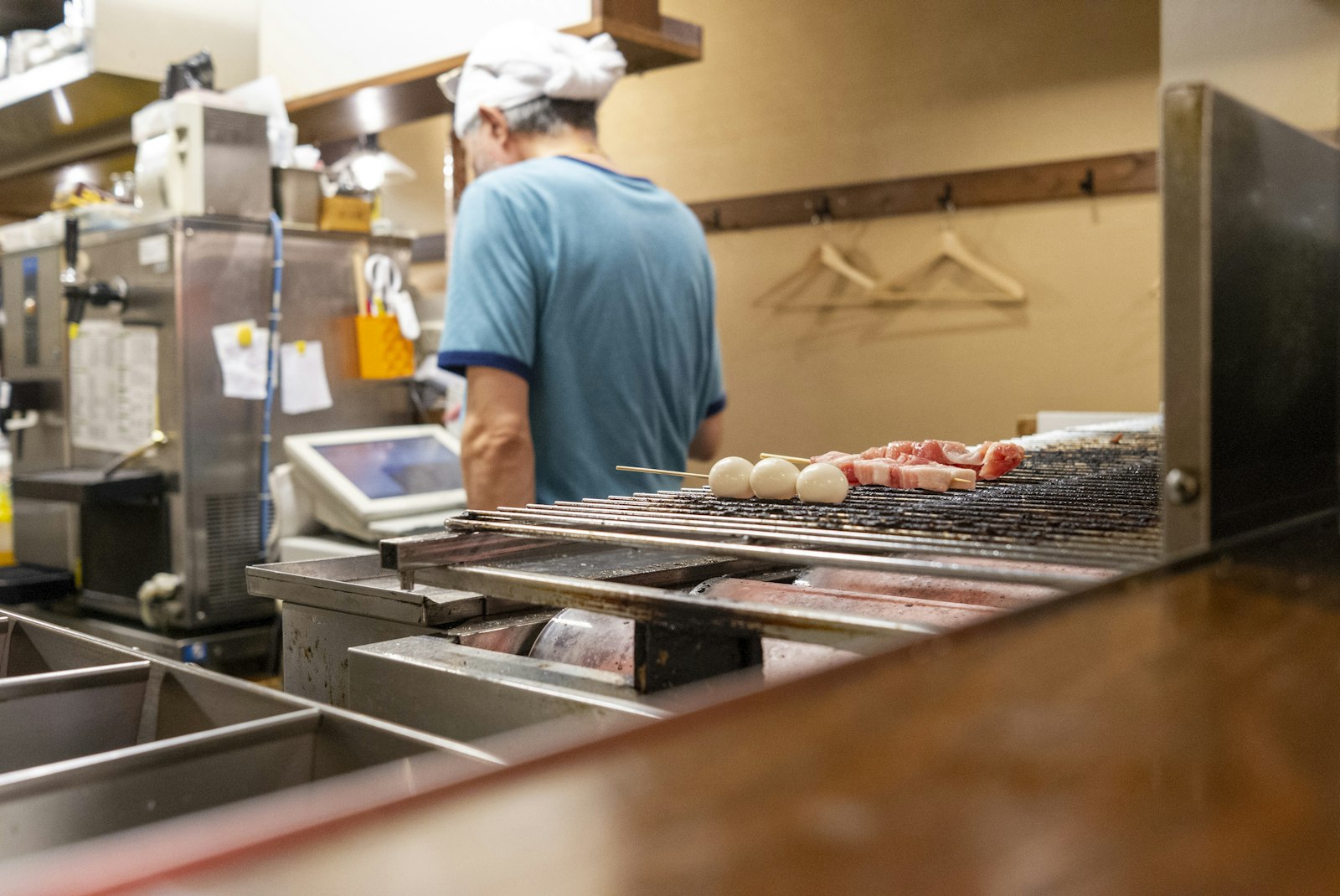
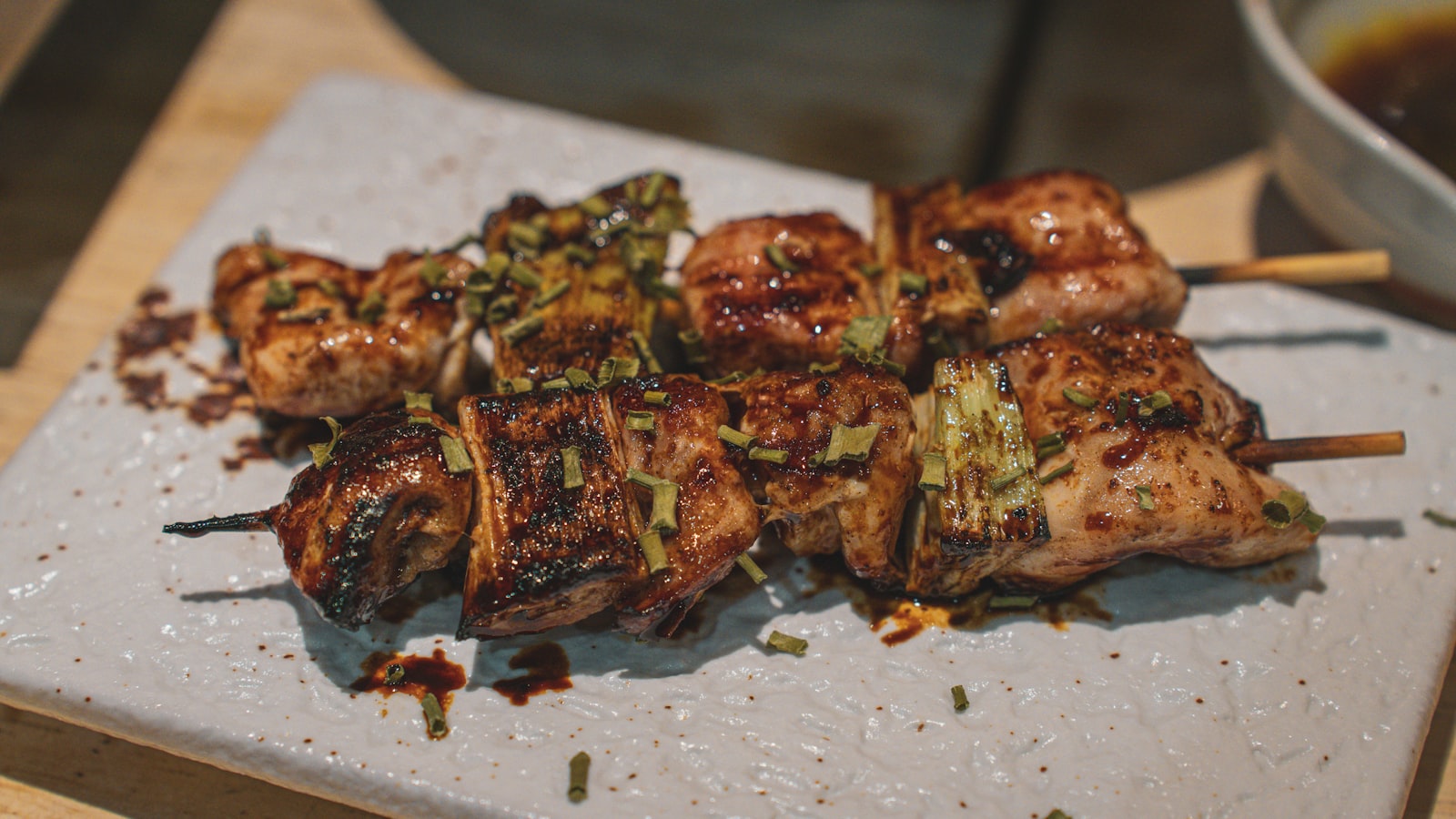
At the yakitori counters — chicken, on sticks, over binchōtan charcoal. Momo (thigh), negima (thigh with spring onion, the safe default), tsukune (minced chicken meatball), kawa (crispy skin), nankotsu (cartilage, oddly addictive). Ordered shio (salt) or tare (sweet soy glaze). Salt for good chicken, tare for everything else.
At the motsuyaki counters — grilled offal, the specialty of Omoide Yokocho and much of old Tokyo. Shiro (intestine), reba (liver), hatsu (heart). This is where the alleys came from, when offal was what was affordable in the 1940s. It’s better than it sounds and cheaper than everything else.
Elsewhere in the alleys — kushikatsu (deep-fried skewers; the communal dipping sauce is strictly no double-dipping), oden (things simmered in dashi, the winter staple), motsunabe (offal hot-pot, for a table of two or more), and at Ebisu Yokocho, niku-zushi.
To drink — draft beer (nama), chūhai or highball (shochu or whisky with soda; the standard, and the cheapest way to drink all night), hoppy (a beer-flavoured mixer served with a shot of shochu — order a nakawari for a refill of the shochu, and you have discovered how Tokyo drinks on a budget), and sake, usually served cold or warm by the small glass.
If you have a dietary restriction, be direct and specific before ordering. These kitchens are small and improvisation is limited — vegetarian options in a yakitori counter are genuinely scarce, and dashi (fish stock) is in nearly everything.
Practical Logistics
When to go. Doors open around 17:00–18:00. The alleys fill between 19:00 and 21:00 and most close around midnight, with last orders 30 to 60 minutes before. Yurakucho’s under-the-track venues run late; Ameyoko is a daytime market.
Best night. Tuesday through Thursday. Weekends are shoulder-to-shoulder and the counters have no room to be friendly. Monday, some owner-operated bars simply close.
The last train is the real deadline. Tokyo’s trains stop around midnight to 01:00 depending on the line, and taxis after that are expensive. Know your last connection before your second drink. Our guide to what to do in Tokyo after 10pm covers your options if you miss it.
Fire safety, briefly. These are wooden buildings from the 1940s, packed tight. Omoide Yokocho lost part of the alley to a fire in 1999 and has been serious about prevention ever since. Smoking rules vary by venue and are posted — follow them.
For official area information, the Tokyo Metropolitan Government’s yokocho guide is a useful cross-reference, and Omoide Yokocho maintains its own official English-language site with the alley’s full history.
Yokocho Tokyo Alley Bars FAQ
Are yokocho foreigner-friendly? Broadly, yes — and increasingly so. Ebisu Yokocho, Omoide Yokocho, and much of Golden Gai see international visitors nightly and are set up for it. Harmonica Yokocho and Nakano are more local. A small number of individual bars anywhere will decline non-Japanese-speaking customers, usually because a single person is running the whole operation. Move to the next door.
Do I need a reservation? No. Yokocho bars generally don’t take them, which is the point — you walk, you look, you sit where there’s space.
Can I go alone? Solo is arguably the ideal way to do this. Counter seating means you’re sitting beside people, not opposite them, and one seat is far easier to find than four. Golden Gai and Nonbei Yokocho are the most conversational.
Is it safe for women? Yes. These are small, well-lit, owner-run venues on busy lanes, and Tokyo’s baseline street safety is very high. Standard sense applies about touts on the approach streets, as it does for everyone.
What’s the difference between a yokocho and a regular izakaya? Scale and format. A modern izakaya is a restaurant with tables, a printed menu, table service, and often a touchscreen. A yokocho bar is a counter with six seats and one person cooking. Choose an izakaya for a long sit-down dinner with a group; choose a yokocho for a moving, three-stop night.
How many should I visit in one evening? Two or three bars within one alley district. Don’t try to cross the city — Shinjuku’s two alleys in one night is ambitious enough.
What do you do in Tokyo After 10?
Join our Tokyo Nightlife Private Tour
You deserve better than overpriced bars and missed opportunities. We’re here for you.
See the Alleys With Someone Who Knows the Doors
Here’s the honest limitation of any written guide, this one included: it can tell you which alley to go to, but it can’t get you through the specific door where the owner will pour you something off-menu and introduce you to the regular on the next stool.
With yokocho Tokyo alley bars, that last step is a language and relationship problem, not an information problem. It’s why a lot of visitors stand at the mouth of Golden Gai for ten minutes, photograph the lanterns, and go find a chain izakaya instead.
If you’d rather skip that part, our Tokyo After 10 nightlife tour takes small groups through the alleys with a local guide who knows which counters have space, which owners enjoy the conversation, and how to order the thing that isn’t written on the wall. You get the yokocho night people describe when they get home — not the one where you hovered outside and left.
Either way, go. Pick an alley from the map above, show up hungry around seven, and turn down the gap between the buildings.