Photo by <a href="https://unsplash.com/@domsson?utm_source=tokyodeepnightlife&utm_medium=referral">Julien</a> on <a href="https://unsplash.com/?utm_source=tokyodeepnightlife&utm_medium=referral">Unsplash</a>
Walk out of the north exit of Kichijoji Station, turn left, and within sixty seconds the city changes texture. The department stores stop. The ceiling drops to somewhere around head height. And you are standing at the mouth of Harmonica Yokocho in Kichijoji — a lattice of covered lanes barely wide enough for two people to pass, holding roughly a hundred businesses in a footprint you could walk across in two minutes.
Most travelers never make it here. They do Shinjuku, they do Shibuya, and they go home having queued for a photo in an alley that is now mostly other tourists queueing for photos. Kichijoji is fifteen minutes from Shinjuku on the JR Chuo Line and it is still, overwhelmingly, a place where Tokyo drinks for Tokyo. That is the whole argument for coming.
This guide covers what the alley actually is, which counters are worth your two hours, and — the part nobody explains — how to walk into a six-seat bar where nobody speaks English and come out having had a good night.
Contents
- What Is Harmonica Yokocho?
- How to Get to Harmonica Yokocho in Kichijoji
- From Black Market to Bar Crawl: A Very Short History
- Day Versus Night: Two Completely Different Alleys
- Where to Eat and Drink in Harmonica Yokocho
- Tecchan (てっちゃん) — Yakitori
- Minmin (みんみん) — Gyoza and Chinese
- Ahiru Beer Hall (あひる) — Standing Beer and Wine
- Kopanda (コパンダ) — Playful Izakaya
- Harmonica Quina — Okinawan
- Pollo — Roast Chicken
- Katakuchi (片口) — Sashimi and Sushi
- Amane (あまね) — Taiyaki
- Harmonica Kitchen — Izakaya and Chinese
- Looking for Adult Entertainment Services in Tokyo? Download this
- How to Actually Order: The Part Nobody Explains
- A Two-Hour Harmonica Yokocho Crawl
- Harmonica Yokocho vs Omoide Yokocho vs Golden Gai
- Five Mistakes First-Timers Make
- What Else Is Nearby
- What do you do in Tokyo After 10?Join our Tokyo Nightlife Private Tour
- Doing Harmonica Yokocho With Someone Who Knows It
- About the Author
What Is Harmonica Yokocho?
Yokocho (横丁) means “side street” — the narrow service lanes that grew up beside Japan’s main roads. In practice the word now means something more specific: a dense cluster of tiny bars and eateries, usually postwar, usually crammed shoulder to shoulder.
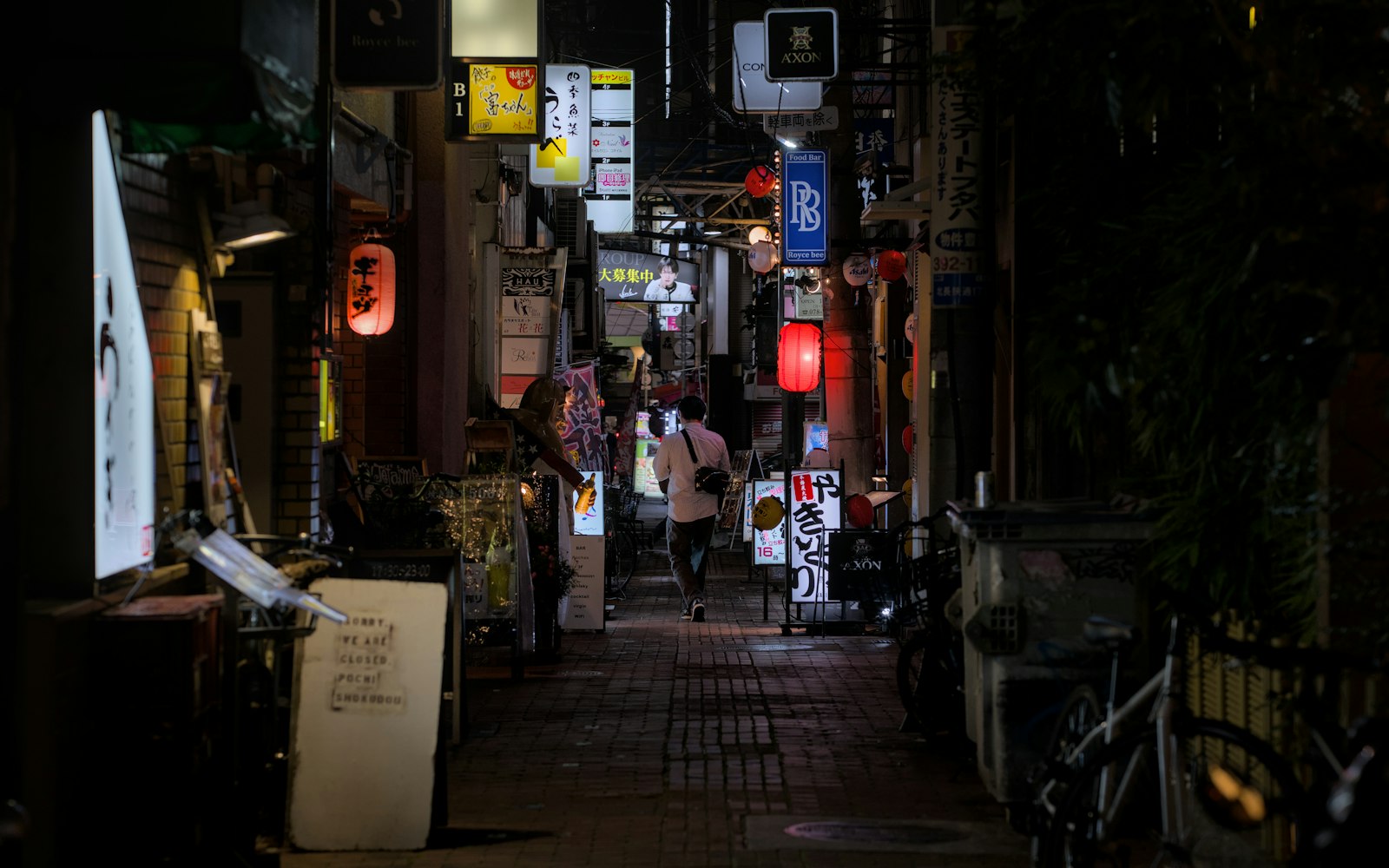
Harmonica Yokocho earns its name from its shape. The shops are so narrow and so tightly stacked that the row was said to resemble the reeds of a harmonica. Stand at one end and look down the lane and the comparison lands immediately — sliding door, sliding door, sliding door, each one a different business, some of them no wider than a generous hallway.
The official count sits at around a hundred businesses. What surprises most first-time visitors is how varied that hundred is. It is not a hundred identical izakaya. Within a few dozen meters you will pass a yakitori grill, an Okinawan taco rice counter, a standing beer hall, a Chinese gyoza shop with a permanent queue, a sushi counter, a taiyaki stall, a pickle shop, and a boutique selling clothes. The alley has a full daytime life that the nightlife crowd never sees.
If this is your first yokocho, it helps to know the category before you arrive — our guide to the best yokocho alleys in Tokyo maps how Harmonica Yokocho fits against the other survivors.
How to Get to Harmonica Yokocho in Kichijoji
Access is the easiest part of the trip.
Address: Kichijoji Honcho 1-chome to 2-chome, Musashino City, Tokyo Station: Kichijoji Station, North Exit — about one minute on foot Lines: JR Chuo Line / JR Sobu Line, and the Keio Inokashira Line
From Shinjuku, the JR Chuo Line gets you to Kichijoji in roughly fifteen minutes. From Shibuya, the Keio Inokashira Line takes about twenty. Either way it is a shorter trip than most people assume when they hear “west Tokyo,” and it costs a few hundred yen.
Come out of the north exit specifically. The alley begins essentially at the station plaza, tucked to the left behind the row of shops — you do not need a map to find the entrance, though you may well need one to find your way back out. The lanes cross each other, most of them look alike, and phones lose GPS accuracy under the low roofing. Drop a pin before you go in.
The official Tokyo tourism guide lists Harmonica Alley if you want to confirm the location on an authoritative map.
From Black Market to Bar Crawl: A Very Short History
Harmonica Yokocho began in the wake of the Second World War as a black market — an unlicensed open-air trading ground that sprang up next to the station in the late 1940s, when official food distribution had collapsed and Tokyo bought what it needed from whoever had it.
That origin is the single most important thing to understand about the place, and it explains the architecture. The lanes are that narrow because nobody planned them. Stalls were staked out, then walled in, then roofed over, then inherited. The shop widths you see today are the footprints of postwar market stalls that never moved.
Most of Tokyo’s black-market alleys were bulldozed during the boom decades. Harmonica Yokocho survived, and from the late 1990s onward it did something more interesting than simply surviving: it started taking in new blood. Young operators moved into the old stalls with Okinawan food, Belgian beer, Thai kitchens and design-forward interiors, while the Showa-era holdouts kept trading beside them. The result is an alley that is genuinely old without being a museum piece.
The clearest illustration is Tecchan, a yakitori shop whose interior was redesigned in the mid-2010s by the architect Kengo Kuma — the same Kengo Kuma responsible for Tokyo’s National Stadium — using recycled LAN cables and recycled acrylic as wall and furniture material. A postwar skewer joint with a world-famous architect’s interior, in an alley that started as a black market, is about as Kichijoji as it gets.
Day Versus Night: Two Completely Different Alleys
Harmonica Yokocho has two personalities, and which one you meet depends entirely on your arrival time.
Daytime (roughly 11:00–17:00). Shutters are up on the retail side. A fishmonger that has traded since the Showa era, a pickle seller, sweets makers, and small clothing shops are open, and a handful of kitchens serve lunch. Crucially, several bars are already pouring. Day drinking in the alley is completely normal and carries no stigma whatsoever — you will find people two beers deep at 1pm on a Tuesday, and nobody thinks anything of it. If crowds and cigarette smoke are not your thing, this is your window.
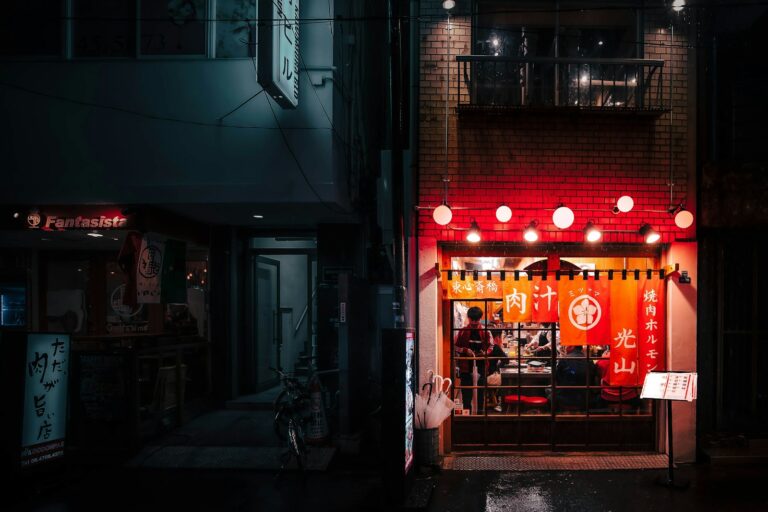
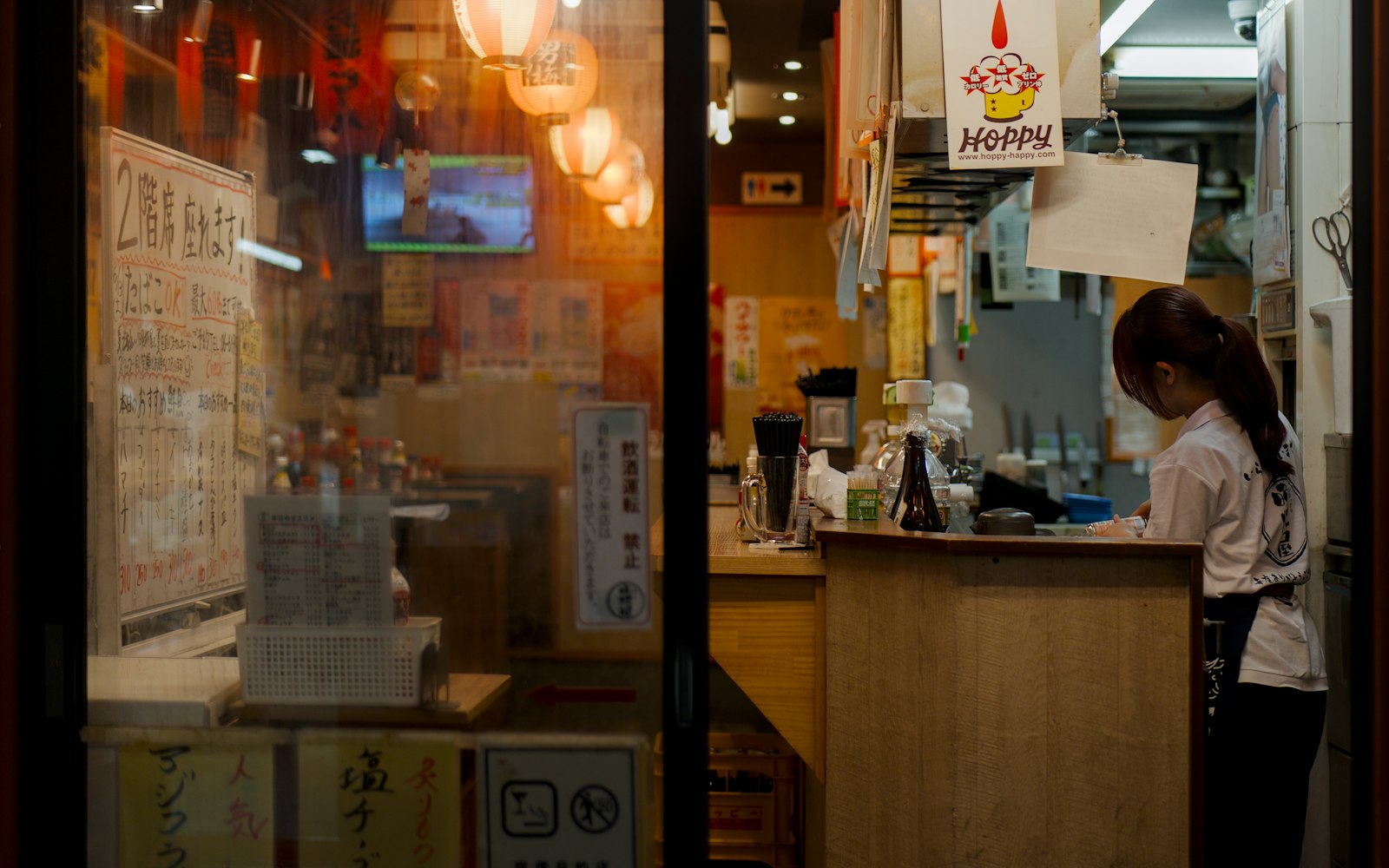
Evening (18:00–22:00). This is the alley the photographs are of. Red lanterns on, smoke coming off the grills, every counter full, conversations spilling between shops because the “walls” are often just a curtain and a sliding door. It is loud, tight and genuinely good fun. It is also the hardest time to get a seat.
There is also a monthly Sunday morning market in the alley, typically starting early — worth checking locally if you happen to be in Kichijoji on a Sunday.
The sweet spot for most visitors is 17:00–18:30. The lanterns are lit, the grills are going, and seats still exist.
Where to Eat and Drink in Harmonica Yokocho
A caveat that matters more here than almost anywhere in Tokyo: hours and prices move constantly in this alley. Shops are tiny owner-operated businesses, days off shift, and a place that was open last month may be closed this week. Treat the list below as a starting shortlist, not a schedule.
Tecchan (てっちゃん) — Yakitori
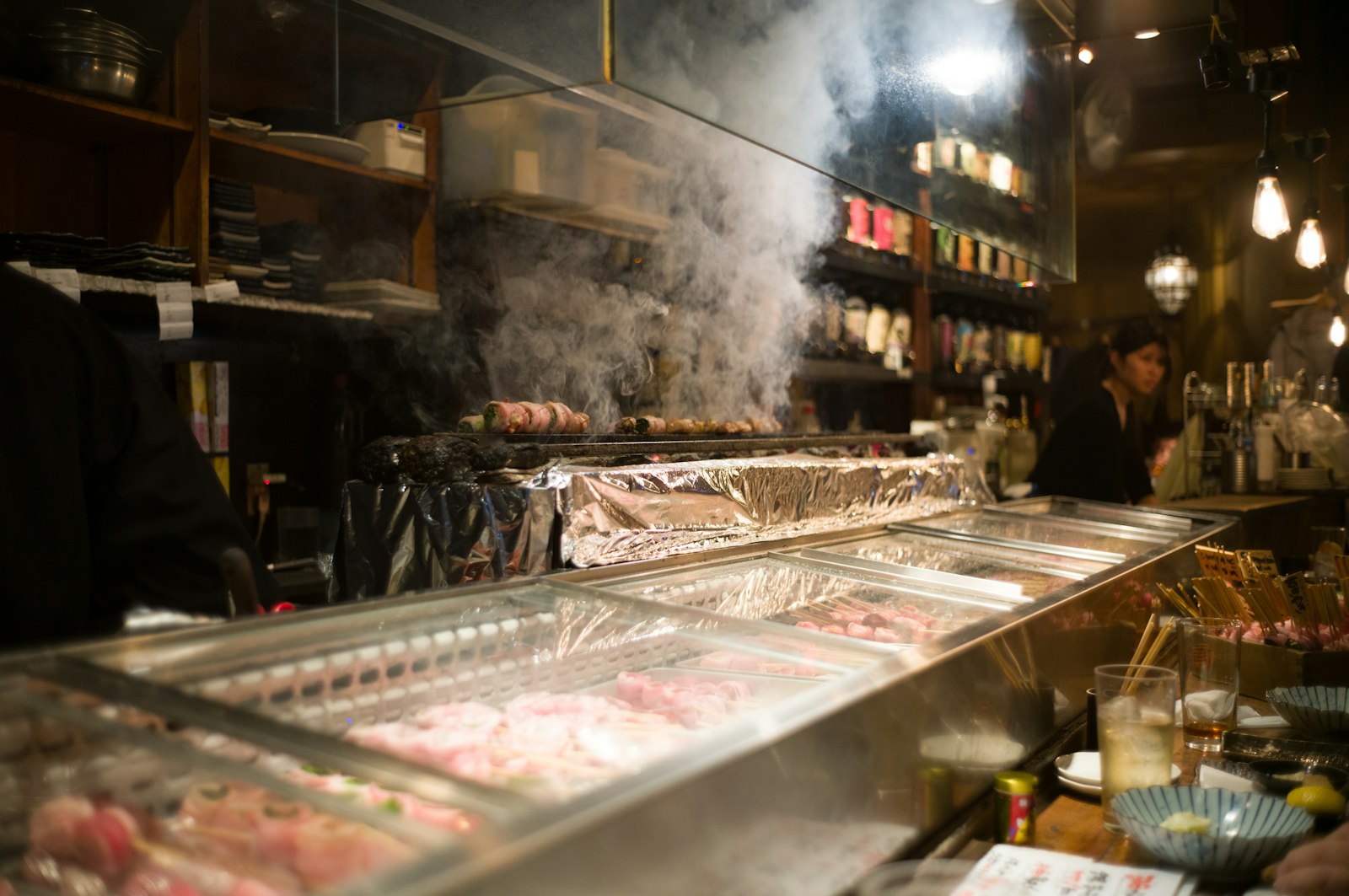
The alley’s most famous counter, and the Kengo Kuma interior mentioned above. Pork skewers — cheek, belly, cartilage — off the charcoal, draft beer and highballs to go with them. Solo drinkers are genuinely welcome, which is not true everywhere. Expect a queue from around 18:00.
Minmin (みんみん) — Gyoza and Chinese
Open since 1973 and still drawing a line. The draw is thick-skinned, chewy handmade gyoza, backed by an asari fried rice made with clam stock that locals rate as highly as the dumplings. Small room, counter plus a couple of tables, high turnover. Go early or accept the wait.
Ahiru Beer Hall (あひる) — Standing Beer and Wine
Ground floor is an open standing space; there is a more spacious seated room upstairs, which is a rarity in this alley. Belgian draft, wine and sake, and it doubles as a bottle shop. A good first or last stop precisely because standing means you are never locked in. If standing bars are new to you, our tachinomi guide for Tokyo standing bars covers the format.
Kopanda (コパンダ) — Playful Izakaya
Inventive small plates — smoked egg, potato salad with corned beef — and a panda theme carried through to the beer and one-cup sake. Look for the otsukare set: a drink plus a few daily snacks, which is the single easiest thing to order if you do not read Japanese.
Harmonica Quina — Okinawan
A tiny Okinawan kitchen. Taco rice with toppings you choose, and soki soba noodles. Useful if you want something substantial mid-crawl that is not another skewer.
Pollo — Roast Chicken
Standing-bar format built around roast chicken, crisp outside and juicy inside. Fast, informal, and easy to eat at while holding a drink.
Katakuchi (片口) — Sashimi and Sushi
A modern-feeling counter with barely any separation from the lane. Sashimi, small plates, and short chef’s-choice sushi sets. Worth knowing about for the moment mid-evening when you want fish rather than fried food.
Amane (あまね) — Taiyaki
Daytime rather than nightlife, but it belongs on the list: hanetsuki taiyaki, the version with the crisp caramelized “wings” of overflow batter around the edge. A few hundred yen, eaten standing in the lane.
Harmonica Kitchen — Izakaya and Chinese
One of the multi-floor venues in the alley, with different atmospheres on different floors and a menu built around small single-portion dishes. A reasonable landing spot for a group of three or four, who will struggle to fit anywhere else.
Looking for Adult Entertainment Services in Tokyo? Download this
I’ve spent over a decade exploring and studying Japan’s adult entertainment scene firsthand. If you’d like detailed insider information—including how to choose the right shop, what services are available, and tips for avoiding common mistakes—check out our exclusive E-book.
How to Actually Order: The Part Nobody Explains
This is where most visitors freeze, so here is the whole thing.
Bring cash. Many shops in the alley take cash only. Bring ¥1,000 and ¥5,000 notes rather than ¥10,000s — a bar with six seats does not want to break a large bill, and there are convenience-store ATMs a short walk away on Sun Road if you run short.
Read the door before you enter. If a shop is full, it is full; there is no waiting area. If the owner looks up and smiles or waves you in, you are in. If you sense hesitation, smile, say sumimasen, and move on — a few counters in any yokocho run almost entirely on regulars, and that is their right, not a slight against you.
Order the first drink immediately. Sit, and say nama hitotsu (a draft beer) or highball hitotsu. Ordering a drink on arrival is the baseline courtesy in a Japanese drinking establishment; the food conversation can happen afterward.
Point. Very few shops here have English menus and English-speaking staff are the exception, not the rule. Pointing at what the person next to you is eating and saying kore (“this”) plus hitotsu (“one”) is a complete and entirely normal ordering method. Nobody will think less of you for it. Osusume wa? — “what do you recommend?” — is the other phrase worth memorizing.
Expect a seating charge in some shops. Many Japanese bars apply a small per-person cover (otōshi or seki-ryō) that comes with a little starter dish. It is standard practice, it is not a scam, and it is usually a few hundred yen.
Move on after an hour. Six-seat counters survive on turnover. Two drinks and a couple of plates, then pay and go — that is the rhythm of the alley, and it is also the whole point of a crawl.
Some shops still allow smoking indoors. If that is a problem for you, standing bars and the outdoor-facing counters are your friends.
For the broader rules of the room, our izakaya etiquette guide for foreigners goes deeper on ordering, paying, and the customs that surprise people.
A Two-Hour Harmonica Yokocho Crawl
The Japanese term is hashigo-zake — “ladder drinking,” one rung per bar. A workable first-timer route:
- 17:30 — Start standing. Open at a standing bar with a beer. Low commitment, and it lets you watch the alley fill up while you get your bearings.
- 18:15 — Skewers. Move to a yakitori counter while the queue is still short. Beer or highball, four or five skewers, let the grill smoke do its work.
- 19:15 — Something that isn’t grilled. Reset your palate with sashimi, Okinawan food, or gyoza.
- 20:15 — Pick a door at random. By now you know how the alley works. Walk until a shop looks right and go in. This is the stop you will actually remember.
Budget roughly ¥2,000–3,000 per stop including drinks as a planning figure — cheaper at standing bars, more where you sit down and eat properly.
Harmonica Yokocho vs Omoide Yokocho vs Golden Gai
All three are postwar alleys. They are not interchangeable.
| Harmonica Yokocho | Omoide Yokocho | Golden Gai | |
|---|---|---|---|
| Location | Kichijoji | Shinjuku | Shinjuku |
| Mainly | Food and drink, plus daytime retail | Yakitori and motsu | Drinking, tiny themed bars |
| Crowd | Mostly local | Heavily tourist | Mixed, tourist-leaning |
| Cover charges | Uncommon to modest | Modest | Common, sometimes steep |
| Best for | Eating your way along a crawl | One atmospheric yakitori stop | Bar conversation, late night |
The short version: Golden Gai is for drinking and talking, Omoide Yokocho is for one photogenic yakitori dinner, and Harmonica Yokocho is for actually eating and drinking your way through an evening among locals. If you want the Shinjuku comparison in full, see our Omoide Yokocho guide.
Five Mistakes First-Timers Make
- Arriving at 20:30 on a Friday and expecting a seat. You will spend your evening walking in circles. Come earlier or come on a weekday.
- Arriving with only a ¥10,000 note. Break it at a convenience store before you go in.
- Trying to keep the whole group together. Six-seat counters cannot absorb five people. Split into pairs, agree on a meeting shop, and reunite later. Groups larger than four should look at the multi-floor venues.
- Committing to one shop for three hours. You came for a hundred businesses. Use them.
- Not checking the last train. Kichijoji is well connected, but it is west of the center, and the last trains toward Shinjuku and Shibuya run earlier than people expect. Check before your third drink, not after.
What Else Is Nearby
Kichijoji consistently ranks near the top of “most desirable Tokyo neighborhood” surveys, and the alley is not the only reason.
Inokashira Park is about five minutes’ walk south — a large pond with rowboats, a small zoo, and one of the better cherry blossom settings in the city. Go before dinner; it is a genuinely lovely late-afternoon walk that pairs perfectly with an early alley start.
Sun Road is the covered shopping arcade running north from the station, good for a rainy-day wander and for the convenience-store ATM you may need.
The Ghibli Museum in Mitaka is a walk across the park, though tickets must be bought in advance and sell out well ahead.
What do you do in Tokyo After 10?
Join our Tokyo Nightlife Private Tour
You deserve better than overpriced bars and missed opportunities. We’re here for you.
Doing Harmonica Yokocho With Someone Who Knows It
Here is the honest assessment. Harmonica Yokocho is not dangerous, it is not a rip-off, and there is no reason you cannot do it alone — plenty of people do, and the tips above are most of what you need.
What you cannot easily do alone is get inside it. The counters where the owner has been pouring for thirty years, the conversations at the bar that turn a drink into an evening, the shop that looks closed but isn’t — those are unlocked by language and familiarity rather than by research. The difference between standing in an atmospheric alley and being welcomed into it is usually one person who can translate both the menu and the room.
That is the gap our guides fill. Kokyo Tours runs small-group and private Tokyo nightlife tours with local guides built around exactly this kind of alley — the ordering, the introductions, and knowing which door to open on a given night. Whether you come with us or go in on your own, go before the rest of Tokyo’s alleys disappear. This one has been lucky for eighty years, and luck is not a plan.
Prices, opening hours and shop lineups in Harmonica Yokocho change frequently. Verify anything time-sensitive locally before you go.