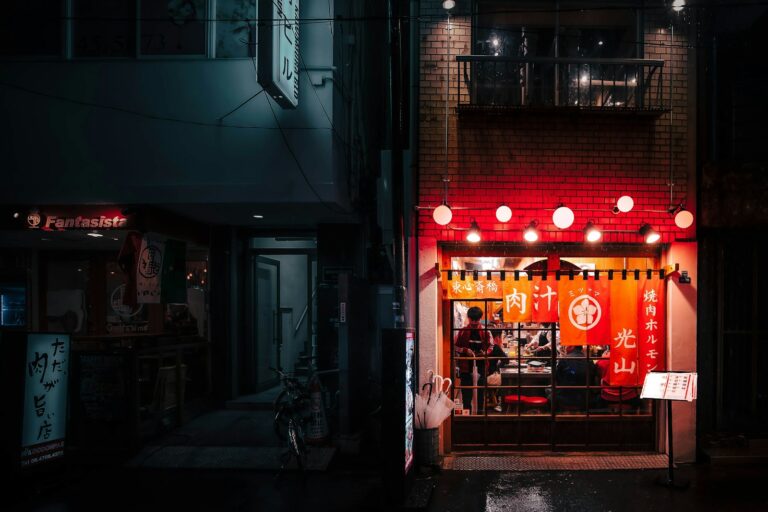
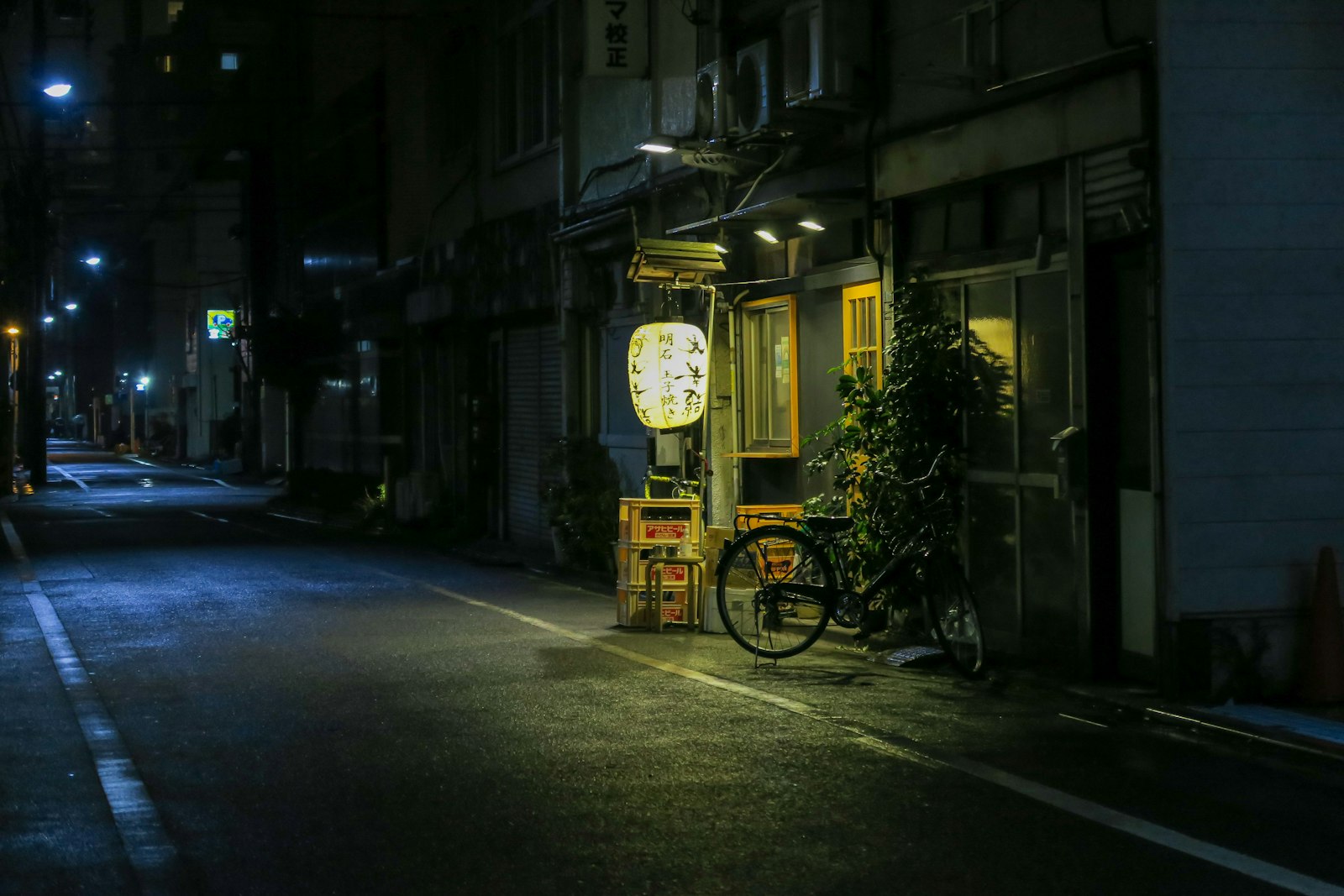
Photo by <a href="https://unsplash.com/@kugedo6060?utm_source=tokyodeepnightlife&utm_medium=referral">Shigeki Wakabayashi</a> on <a href="https://unsplash.com/?utm_source=tokyodeepnightlife&utm_medium=referral">Unsplash</a>
Most advice about the language barrier in Tokyo nightlife is useless, because it solves the wrong problem. You’ll be told to download a translation app and learn to say kanpai. Fine. But nobody has ever been stopped at a bar door because they couldn’t say “cheers” — they were stopped because they couldn’t read the small handwritten sign next to the door, didn’t know what the ¥800 line item on the bill was for, or walked into a six-seat counter where the owner genuinely could not host them and neither party knew how to end the conversation gracefully.
This Tokyo nightlife English guide is about those three things. Not tourist phrases — the actual friction points where not reading Japanese costs you money, a good night, or both. By the end you should be able to walk down a Shinjuku alley, look at ten doors, and know which two you can open.
Contents
- The real language barrier isn’t translation — it’s the door and the bill
- A Tokyo nightlife English guide to venue types: what actually works
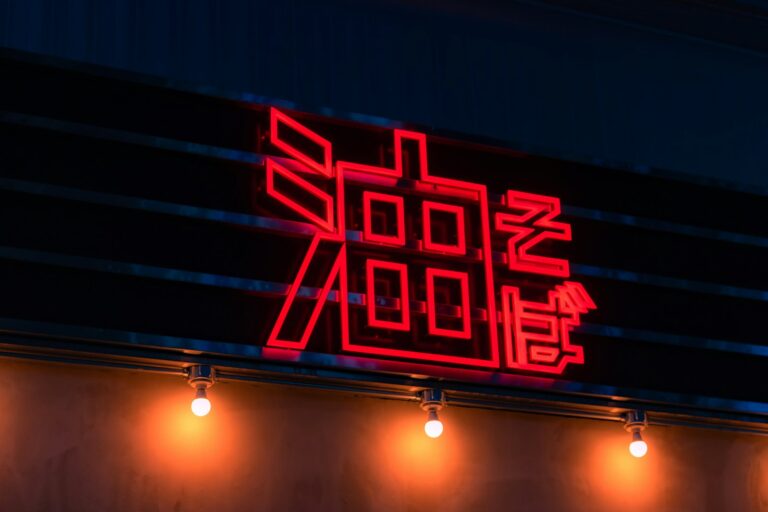
- How to read a Tokyo bar door before you walk in
- Nine phrases that do ninety percent of the work
- The money conversation, in English, before you sit down
- Where to go for an easy English night, district by district
- Your phone: what actually works at a bar counter
- Etiquette that translates without a single word
- When an English-speaking guide is actually worth paying for
- Tokyo nightlife English guide: frequently asked questions
- What do you do in Tokyo After 10?Join our Tokyo Nightlife Private Tour
- Skip the guesswork and let someone else read the door
- About the Author
The real language barrier isn’t translation — it’s the door and the bill
Ordering a beer is easy. Point, hold up one finger, done. Japanese bar staff deal with pointing every single night and are extremely good at it.
The two places where English actually fails you are at either end of the visit.
At the door, Tokyo nightlife runs on a category of information that is almost never translated: whether this particular room is open to a stranger tonight. A bar can be open, lit, half-empty, and still not for you — because it’s privately booked, because it’s a members’ room, or because the owner runs a six-seat counter in Japanese and knows that hosting you badly is worse than not hosting you. None of that is hostility. It’s capacity. But it’s written in Japanese, and if you can’t read it you either miss good bars or push into rooms where you’re not wanted.
At the bill, Japan uses charges that don’t exist in most Western drinking cultures — a compulsory snack fee, a seat fee, a late-night surcharge, a service percentage — and they are frequently not mentioned out loud because locals already know. There is nothing shady about this in an ordinary bar. But it means the number at the end can be 30–40% above what you mentally added up, and if you can’t ask about it in advance, you can’t plan around it.
Everything in the middle — the actual drinking, the conversation, the fun — works fine on gestures and goodwill. So this guide spends its time on the two ends.
A Tokyo nightlife English guide to venue types: what actually works
Not all of Tokyo’s night scene has the same language difficulty. It’s a spectrum, and knowing where a venue sits before you commit to it is the single most useful skill in this whole guide.
Tier 1: Comfortable in English, no preparation needed
These places serve non-Japanese speakers constantly and have built for it:
- Hotel bars — English menus, trained staff, transparent pricing. Expensive, but nothing will surprise you.
- Large nightclubs — Roppongi and Shibuya clubs run English door policies, English-speaking staff, and card payment. Music is the language anyway.
- Chain izakaya in Shinjuku, Shibuya and Roppongi — tablet ordering with an English toggle, photos of every dish, itemized bills. Not the most atmospheric room in Tokyo, but genuinely frictionless.
- Themed bars and concept bars — built for visitors, staffed accordingly.
- Craft beer bars and listening bars in central districts — the staff skew younger and international-facing.
- Shinjuku Ni-chome, Tokyo’s LGBTQ+ nightlife district — a dense cluster of small bars where several long-running venues (AiiRO Cafe and Advocates are the two most consistently recommended English-friendly starting points) are explicitly welcoming to visitors and used to mixed-language rooms.
If your priority is a relaxed night with zero navigation stress, you can build an entire evening from this tier alone.
Tier 2: Workable with a phone and a bit of nerve
- Independent izakaya away from the main station exits — usually a Japanese-only paper or wall menu, staff who speak little English but are willing. Camera translation plus pointing gets you through.
- Standing bars (tachinomi) — cheap, fast, no seat charge, and the format itself does the social work. You stand next to people; conversation happens or it doesn’t.
- Yokocho alley bars — the drinking alleys under and beside the train tracks. Enormously variable: some counters have laminated English menus in the window, some have none.
- Golden Gai — roughly 200 tiny bars stacked into a few blocks, each seating five to ten people. Plenty now advertise English menus and welcome signs in the window; others post regulars-only notices. The complete Golden Gai guide breaks down which lanes to try first. Budget for a seat charge of roughly ¥500–¥1,500 per person on top of drinks that generally run ¥700–¥1,500 a glass — sometimes the charge includes the first drink, so ask.
Tier 2 is where the best nights usually happen. It’s also where the door-reading skill in the next section pays for itself.
Tier 3: Where English genuinely runs out
Be honest with yourself about these:
- Snack bars — small counter bars where you’re paying, in effect, for conversation with the mama who runs it. Without shared language, the entire product doesn’t exist.
- Traditional hostess clubs and host clubs — same logic, higher stakes and higher prices. A handful cater to English speakers deliberately; the rest do not, and the gap between those two is where most bad experiences happen. We wrote a separate breakdown of English-speaking hostess clubs in Tokyo precisely because the general advice doesn’t transfer.
- Old-school neighborhood counters in residential districts — six seats, all regulars, owner in their seventies. Wonderful rooms. Not first-visit rooms.
There’s no shame in Tier 3 being closed to you on a solo night. It’s the specific tier where bringing someone who speaks both languages changes the venue from inaccessible to excellent — more on that at the end.
How to read a Tokyo bar door before you walk in
This is the part almost no Tokyo nightlife English guide teaches, and it’s the highest-value thing on this page. Ten seconds of reading the doorway tells you more than any review site.
| What you see | Reading | What it actually means |
|---|---|---|
| 会員制 | kaiinsei | Members only. Don’t try the door. |
| 一見さんお断り | ichigen-san okotowari | No first-time customers without an introduction. Traditionally a referral system; today usually means “regulars keep this room alive.” Walk on. |
| 貸切 | kashikiri | Privately booked tonight. Nothing to do with you. |
| 準備中 | junbichū | Preparing — not open yet, even if the lights are on. |
| 営業中 | eigyōchū | Open for business. Go in. |
| 英語メニューあり / English Menu | — | The clearest possible green light. It’s a deliberate signal. |
| 現金のみ | genkin nomi | Cash only. Check your wallet before you sit. |
| お通し / チャージ / 席料 | otōshi / chāji / sekiryō | There’s a per-person charge. If a number is posted, that’s your floor price. |
| 飲み放題 | nomihōdai | All-you-can-drink, usually time-limited (90 or 120 minutes). |
| Handwritten price list in the window | — | Almost always a good sign — a bar posting prices is a bar not planning to surprise you. |
Two rules that flow from this table:
A posted price is a promise. Bars that want your business make their pricing legible from outside. Bars that hide it aren’t necessarily crooked, but you should ask before sitting.
No sign at all, plus a closed opaque door, plus no menu? That’s a room for people who already know what’s inside. Not a puzzle to solve — just not your bar tonight.
Nine phrases that do ninety percent of the work
Skip the phrasebook chapter on weather. These are the lines that actually get used across a night out, in the order you’ll need them.
- Sumimasen — “Excuse me.” Opens every interaction in Japan. Use it constantly.
- Hitori desu / Futari desu — “One person / two people.” Say it at the door with the matching number of fingers. This is the single most useful phrase in Tokyo nightlife, because seat capacity is the real constraint in small bars.
- Eigo no menyū arimasu ka? — “Do you have an English menu?” Often the answer is a laminated sheet kept under the counter.
- Otōshi wa arimasu ka? — “Is there a table charge?” Asking this before you sit marks you as someone who knows the system. Nothing changes the tone of the evening faster.
- Chāji wa ikura desu ka? — “How much is the cover charge?” The follow-up when the answer to #4 is yes.
- Kore o kudasai — “This one, please.” Said while pointing. Carries an entire meal.
- Osusume wa nan desu ka? — “What do you recommend?” You will not understand the answer. Nod and say sore de (“that one”). This is how you end up eating the best thing on the menu.
- Okaikei onegaishimasu — “The check, please.” Or cross your index fingers into an X — the universal Japanese gesture for the bill.
- Gochisōsama deshita — “Thank you for the food and drink,” said on the way out. It lands warmly every time and costs nothing.
Nine phrases. Twenty minutes of practice. They will get you further than a translation app, because they signal effort — and in a small Tokyo bar, visible effort is the thing that actually opens rooms.
The money conversation, in English, before you sit down
Japan’s night pricing has components that don’t exist in most countries, and misreading them is the number one source of “I got scammed” stories that turn out, on inspection, to be ordinary bills.
Otōshi (お通し) is a small dish that arrives unrequested at izakaya. It’s a table charge wearing a costume. Typical range is ¥300–¥700 per person, sometimes up to around ¥1,000 in upmarket rooms. Not optional, not a scam — the standard way small venues charge for your seat.
Seat charge / cover (席料 or チャージ) is the bar equivalent, and it’s the one that stings in Golden Gai and small counter bars: ¥500–¥1,500 per person, per bar. Hop four bars and you’ve spent ¥4,000 before drinking anything. Sometimes it includes a first drink. Ask which.
Service charge (サービス料) — typically a percentage, common in hostess clubs, host clubs and hotel bars, less common in izakaya.
Late-night surcharge (深夜料金) — some venues add a percentage after midnight.
Nomihōdai (飲み放題) — all-you-can-drink for a fixed window, usually 90 or 120 minutes, with last order about ten minutes before the end. Excellent value if you drink at pace, poor value if you don’t.
The English sentence that protects you is short: “How much per person, total, before we sit?” Say it slowly at the door. In any legitimate venue you’ll get a straight answer or a pointed finger at a price list. If you get evasion, a shrug, or “don’t worry, cheap, cheap” — that’s your signal, and it’s the same signal in every language. That specific pattern is the backbone of the street-tout scams we documented in our guide to avoiding scams in Kabukicho.
One more rule that removes an entire category of confusion: do not tip. Not at bars, not at izakaya, not in taxis. Leaving money on the counter creates a small awkward problem for staff, who will often chase you down the street to return it.
Looking for Adult Entertainment Services in Tokyo? Download this
I’ve spent over a decade exploring and studying Japan’s adult entertainment scene firsthand. If you’d like detailed insider information—including how to choose the right shop, what services are available, and tips for avoiding common mistakes—check out our exclusive E-book.
Where to go for an easy English night, district by district
Roppongi — the most international nightlife district in Tokyo, with the highest baseline of English-speaking staff and English menus. The trade-off is that it’s also the most tourist-priced, and the street-tout density is the highest in the city. Great for a first night out, less rewarding on your third.
Shibuya — younger, music-led, dense with chain izakaya and clubs that handle English fine. Slightly less international than Roppongi in the smaller bars, but the big rooms are easy.
Shinjuku — the widest range in Tokyo, and therefore the widest range of language difficulty. Western Shinjuku and the big izakaya near the station are straightforward; Golden Gai is a bar-by-bar lottery; the deeper reaches of Kabukicho are a different proposition entirely. Our Shinjuku nightlife guide maps the district by sub-area.
Shinjuku Ni-chome — small, walkable, and genuinely one of the friendliest places in Tokyo to arrive alone and not speak the language.
Ebisu, Nakameguro, Kichijōji — residential-adjacent neighborhoods with excellent small bars and a lower English baseline. Better on a second or third visit, or with someone who can translate.
A district-level rule of thumb: the closer to a major station exit, the more English. Walk five minutes and the language difficulty rises sharply — along with, usually, the quality and the price-to-value ratio.
Your phone: what actually works at a bar counter
Every Tokyo nightlife English guide tells you to install a translation app, and then stops there. The useful version is narrower: translation apps work in exactly two situations and are clumsy in every other one.
Where they work: camera translation pointed at a printed menu or a posted sign. Google Translate’s camera mode overlays English directly onto Japanese text and handles menus reasonably well. Download the Japanese offline pack before you go — the packs are small (roughly 30–120MB) and basement bars swallow mobile signal.
Where they work less well: real-time conversation. Conversation mode exists and functions, but a loud six-seat bar is a bad acoustic environment, and passing a phone back and forth kills the rhythm of a room where the appeal was the rhythm. It’s fine for one specific question. It is not a way to spend an evening.
Practical setup, five minutes before you leave the hotel: offline Japanese pack downloaded, screenshot of your hotel name and address in Japanese saved to your photos (for taxis, and for when your battery is at 4%), and enough cash for the night. Many small bars remain cash-only.
Etiquette that translates without a single word
In rooms where you share no language, behavior is the whole message. Four things carry:
- Wait to be seated. Even in a nearly empty bar. Small venues manage seat allocation carefully, and walking in and choosing your own stool reads badly.
- Order something reasonably promptly. A seat occupied without an order is the one thing that genuinely strains a six-seat counter.
- Keep your volume at the room’s volume. Tokyo bars are conversational, not shouty. Matching the ambient level does more for how you’re received than any phrase you could learn.
- Pour for the person next to you, not yourself. If someone fills your glass, fill theirs. This reciprocal pour is the most legible friendliness signal in Japanese drinking culture, and it requires zero vocabulary.
Do those four things and you’ll be read as a good guest regardless of what you can say — which, in a small bar, is the entire currency.
When an English-speaking guide is actually worth paying for
Honest answer: most of the city does not require one. Tier 1 is easy, Tier 2 is manageable with a phone and the Tokyo nightlife English guide you just read, and plenty of great nights start with nothing more than pointing at a menu.
A guide changes the math in four specific situations:
- You want Tier 3 access. Snack bars, old-school counters, hostess and host clubs, the six-seat room where the owner has been pouring for thirty years. These aren’t hard because of the door policy — they’re hard because the product is conversation. Someone who can translate in both directions turns an inaccessible room into the best hour of your trip.
- You have one night. Trial and error is genuinely fun with a week to spare. With a single evening, spending ninety minutes finding a bar that has a free seat and an English menu is expensive in the currency that matters.
- You’re in a group of four or more. This is the constraint nobody anticipates. Most of the interesting bars in Tokyo seat five to ten people total. Getting a group of five into three good bars in one night requires someone calling ahead in Japanese.
- You want the money question handled. No door negotiations, no surprise charges, no wondering whether the ¥800 line is legitimate. Someone else asks, in Japanese, before you sit.
If none of those apply, take this page and go. If two or more do, an English-guided night is the cheaper option once you price in the hours you’d otherwise spend standing in an alley reading signs you can’t read.
Tokyo nightlife English guide: frequently asked questions
Can you enjoy Tokyo nightlife without speaking any Japanese? Yes, comfortably. Hotel bars, large clubs, chain izakaya, themed bars, and much of Shibuya, Roppongi and Ni-chome operate in English every night. The nine phrases above cover most of what the rest requires.
Do Tokyo bars have English menus? Many do, and they advertise it — an “English Menu” sign in the window is a deliberate welcome signal. Small independent counters often keep a laminated English sheet under the bar and will produce it if you ask.
Is it rude to use a translation app in a Japanese bar? Not at all. Camera-translating a menu is completely normal and staff are used to it. Long back-and-forth conversation mode is where it gets socially awkward, not the translation itself.
What does “members only” mean on a Tokyo bar door? 会員制 (kaiinsei) means exactly that, and 一見さんお断り (ichigen-san okotowari) means no first-time customers without an introduction. Neither is aimed at foreigners specifically — both are ways small venues protect a regulars-based room. Read them and move to the next door.
How much should I budget for a night of bar hopping in Tokyo? It depends entirely on venue type, but the charges are the part people miss: expect ¥300–¥700 per person for otoshi at an izakaya, and ¥500–¥1,500 per person as a seat charge at small bars like those in Golden Gai — before you order a drink. Ask at the door and you’ll never be surprised.
When do I need to leave to catch the last train? Central Tokyo lines mostly stop between midnight and around 1am, with the Yamanote loop’s final departures generally falling in the 00:30–01:05 window depending on station and direction. Trains restart around 4:30–5:00am. Between those two times your options are a taxi, an all-night venue, or a nap somewhere — plan which one before you’re choosing at 12:50am.
What do you do in Tokyo After 10?
Join our Tokyo Nightlife Private Tour
You deserve better than overpriced bars and missed opportunities. We’re here for you.
Skip the guesswork and let someone else read the door
Everything above is genuinely usable on your own, and if you’re the kind of traveler who enjoys the puzzle, go and enjoy it — Tokyo rewards it.
But if you’d rather spend your night inside the bars than outside them squinting at signage, that’s exactly what KOKYO Tours’ Tokyo After 10 private night tour exists for. A local guide who speaks both languages handles the doors, the charges and the introductions, which means the rooms that are effectively closed to a solo visitor — the six-seat counters, the snack bars, the places with no sign at all — become simply places you walk into.
The language barrier in Tokyo nightlife isn’t really about vocabulary. It’s about who’s standing next to you when the door opens.
For official transport timetables and district-level information in English, the Tokyo Metropolitan Government’s GO TOKYO nightlife pages are a reliable reference to read alongside this Tokyo nightlife English guide.